🛡️ Licensed by Ministry of External Affairs · RA:
B-3413/DEL/COM/1000+/5/11419/2026
📞 +91 96259 66817
📍 15, 2nd Floor, South Patel Nagar, Delhi-110008
📌 What You'll Learn
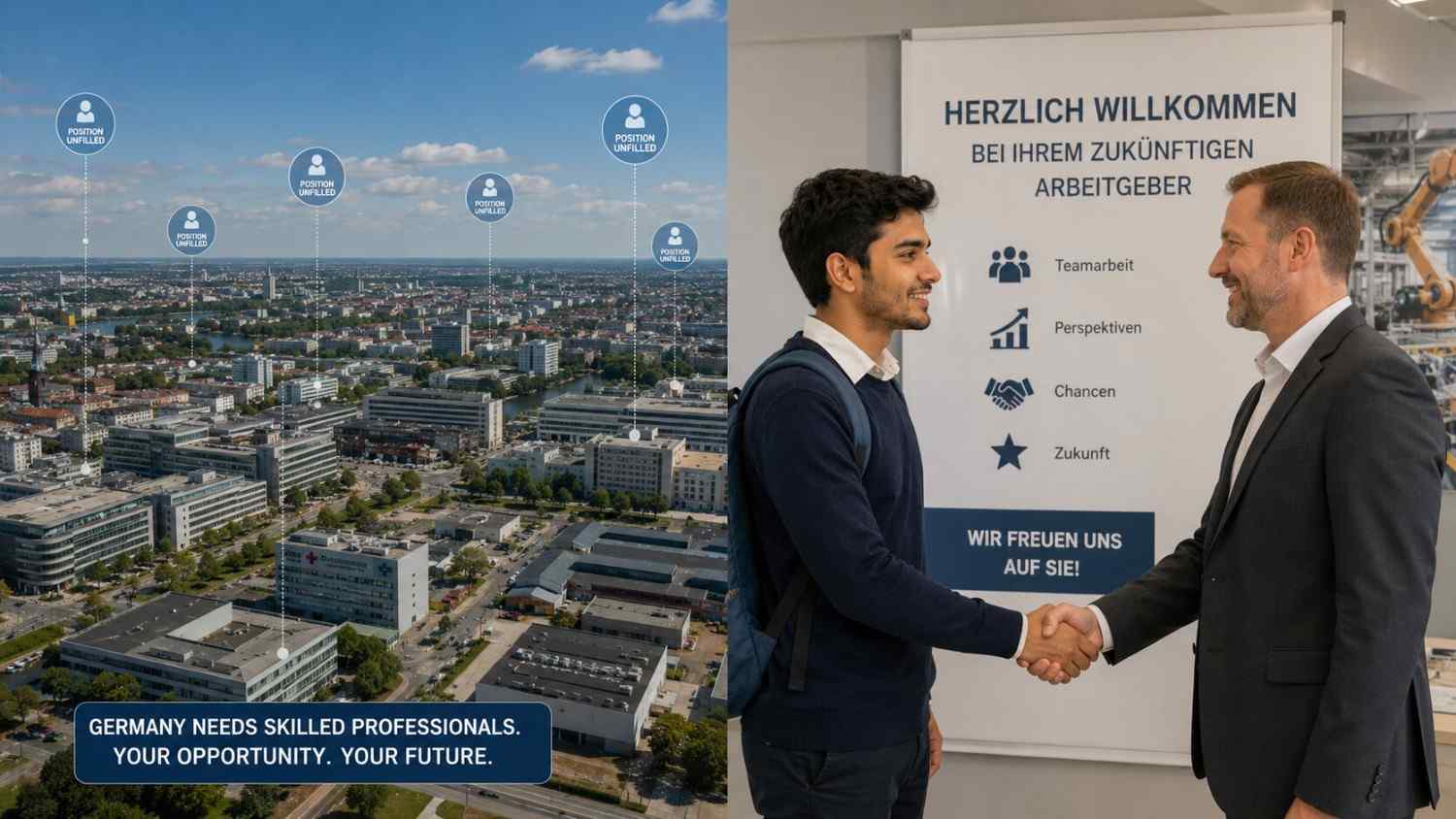
Germany is facing its worst skilled worker shortage in decades. This blog explains what the Fachkräftemangel is, which sectors are most affected, and why Indian students aged 18–25 are uniquely positioned to build a career and a life in Germany through the Ausbildung route.
The word Fachkräftemangel (pronounced: fakh-krefte-mangel) translates directly as "skilled worker shortage." It is not a new problem in Germany — economists have been tracking it for over two decades — but in the 2020s it has become one of the defining challenges facing the German economy. By some estimates, Germany currently has over 1.5 million unfilled skilled worker positions across its economy. Projections suggest this number could rise to 5 to 7 million by 2035 if nothing changes.
The cause is straightforward: Germany has one of the oldest and fastest-ageing workforces in Europe. Large numbers of skilled workers from the post-war generation are retiring each year, and the domestic population of young people entering vocational training is not large enough to replace them. Germany's birth rate has been below replacement level for decades. The workforce is shrinking — and the German economy, the largest in Europe, runs on skilled people.
This structural gap is not a short-term fluctuation. It is a long-term demographic reality. And it is precisely why Germany has been actively changing its immigration laws to welcome young, qualified workers from countries like India.
The shortage is not limited to one or two industries. It spans the entire economy — but certain sectors are in particularly acute need. These happen to overlap significantly with the sectors in which JSJ's Ausbildung Programme operates.
| Sector | Estimated Shortage | Ausbildung Relevant? |
|---|---|---|
| Healthcare & Social Care | 500,000+ positions unfilled | Yes — Sozialassistent, Pflegehelfer, care support roles |
| Mechatronics & Engineering | 350,000+ positions | Yes — Mechatroniker, industrial maintenance |
| Logistics & Warehousing | 200,000+ positions | Yes — Fachlagerist, logistics operatives |
| IT & Software | 150,000+ positions | Yes — IT Systemkaufmann, tech support |
| Hospitality & Gastronomy | 250,000+ positions | Yes — Hotelfachmann, restaurant operations |
| Construction & Trades | 400,000+ positions | Partially — some Ausbildung pathways available |
| Business Administration | 200,000+ positions | Yes — Kaufmann/Kauffrau roles |
What makes this list significant is not just the scale of the shortage — it is the type of roles being left unfilled. These are not entry-level, unskilled jobs. They are qualified, well-paid, socially respected professions. A Mechatroniker earns between €2,800 and €3,600 per month after qualifying. A care sector Fachkraft earns €2,500 to €3,200. These are stable, long-term careers — not temporary work.
The German government has recognised that domestic solutions are not enough. In 2020, the Fachkräfteeinwanderungsgesetz (Skilled Worker Immigration Act) came into force, creating new visa pathways for qualified workers from outside the EU. In 2023, the law was significantly expanded — making it easier for people with vocational qualifications (not just university degrees) to come to Germany and work.
India has been specifically identified as a key partner country. In 2023, German Chancellor Olaf Scholz and Indian Prime Minister Narendra Modi signed a Migration and Mobility Partnership Agreement, which included provisions for increasing the flow of Indian workers and trainees into Germany. This is not informal goodwill — it is a bilateral government agreement that reflects just how seriously Germany is taking its workforce challenge.
For Indian students, this matters enormously. It means that the German government, German employers, and the German economy are actively looking for people like you. The demand is real, the legal framework is in place, and the opportunity window is open right now.
💡 Key Context
The Ausbildung visa is one of the clearest and most stable visa pathways available to Indian students aged 18–25. Unlike study visas (which require a university admission) or work visas (which require a recognised qualification you may not yet have), the Ausbildung visa is designed specifically for people who are coming to Germany to train and qualify. It is the entry point the German system has built for exactly this moment.
Germany needs young, trainable, motivated workers with a strong educational foundation and a willingness to integrate into German workplace culture. Indian students — particularly those from science backgrounds who have completed Class 12 — fit this profile well for several reasons.
First, the educational standard. Indian students who have completed PCB or PCM at Class 12 level have a solid foundation in science, mathematics, and reasoning that maps well onto the demands of German vocational training in health, mechatronics, and technical fields. German employers who have trained Indian Ausbildung candidates consistently note the seriousness with which Indian students approach their studies.
Second, demographics. India has the world's largest youth population. There are hundreds of millions of young Indians aged 15 to 30 — a generation with energy, ambition, and limited local opportunity that matches what Germany urgently needs. The bilateral migration partnership is not coincidental. It is a strategic recognition of this complementarity.
Third, language commitment. Indian students who undertake the 10 to 12-month German language journey from A1 to B2 demonstrate a level of commitment that German employers value. Learning German is not easy. The fact that you do it signals seriousness.
The JSJ Ausbildung Training Programme, in partnership with Destination Germany GmbH, is built specifically to connect Indian Class 12 graduates to German employers who are actively seeking Ausbildung trainees in healthcare and caregiving, mechatronics, logistics, IT, hospitality, and business administration — the very sectors at the heart of the Fachkräftemangel.
Destination Germany GmbH works with 180+ employer partners across Germany. These are real organisations — hospitals, care homes, engineering companies, logistics firms, hotels — with real signed Ausbildungsvertrag contracts for Indian trainees. 583+ candidates have started their Germany journey through this partnership. This is not speculative. The demand exists, and the contracts follow the demand.
The JSJ programme gives you the language (A1 to B2 in 10 to 12 months), the employer match (through Destination Germany), the visa support, and the preparation to walk into a German workplace with confidence. You are not arriving as a favour to anyone. You are arriving as someone Germany needs.
Here is what the Fachkräftemangel means for your life, concretely. It means that when you complete your three-year Ausbildung and hold a German Berufsabschluss, you are not competing desperately for a job in a saturated market. You are walking into a market that has been waiting for you. Your qualification is in demand. Your German language skills are in demand. Your willingness to stay and build a life in Germany is in demand.
The Übernahme rate — the proportion of Ausbildung graduates who are offered permanent employment by their training employer — is around 70 to 80 percent in Germany's shortage sectors. That means seven or eight out of every ten trainees are offered a job before they even finish their training. The path from Ausbildung to permanent employment is well-worn and well-lit.
Post-qualification, a Fachkraft in Germany earns between €2,500 and €3,600 per month. After approximately four years of qualifying employment, you become eligible for the Niederlassungserlaubnis — Germany's permanent residency. This is not the distant dream of a lucky few. It is the normal outcome for people who complete the Ausbildung process properly.
📌 The Bottom Line
Germany's Fachkräftemangel is your opportunity. The country needs workers. The government has opened legal pathways. The employers have signed contracts. The language can be learned. The Ausbildung route exists. What it needs is committed Indian students aged 18–25 who are serious about making Germany their future. That is exactly who the JSJ programme is built for.
📞 Book Your Free Consultation — Jet Set Jobs × Destination Germany
Call / WhatsApp: +91 96259 66817
Email: support@jetsetjobs.in | www.jetsetjobs.in
Ausbildung Programme Germany 2027
Eligibility: Age 18–25 | Class 12 pass | Science background preferred
Programme Fee: ₹2,50,000 + GST in 3 instalments
Free German A1–B2 training included | Stipend: €1,000–€1,300/month