🛡️ Licensed by Ministry of External Affairs · RA:
B-3413/DEL/COM/1000+/5/11419/2026
📞 +91 96259 66817
📍 15, 2nd Floor, South Patel Nagar, Delhi-110008
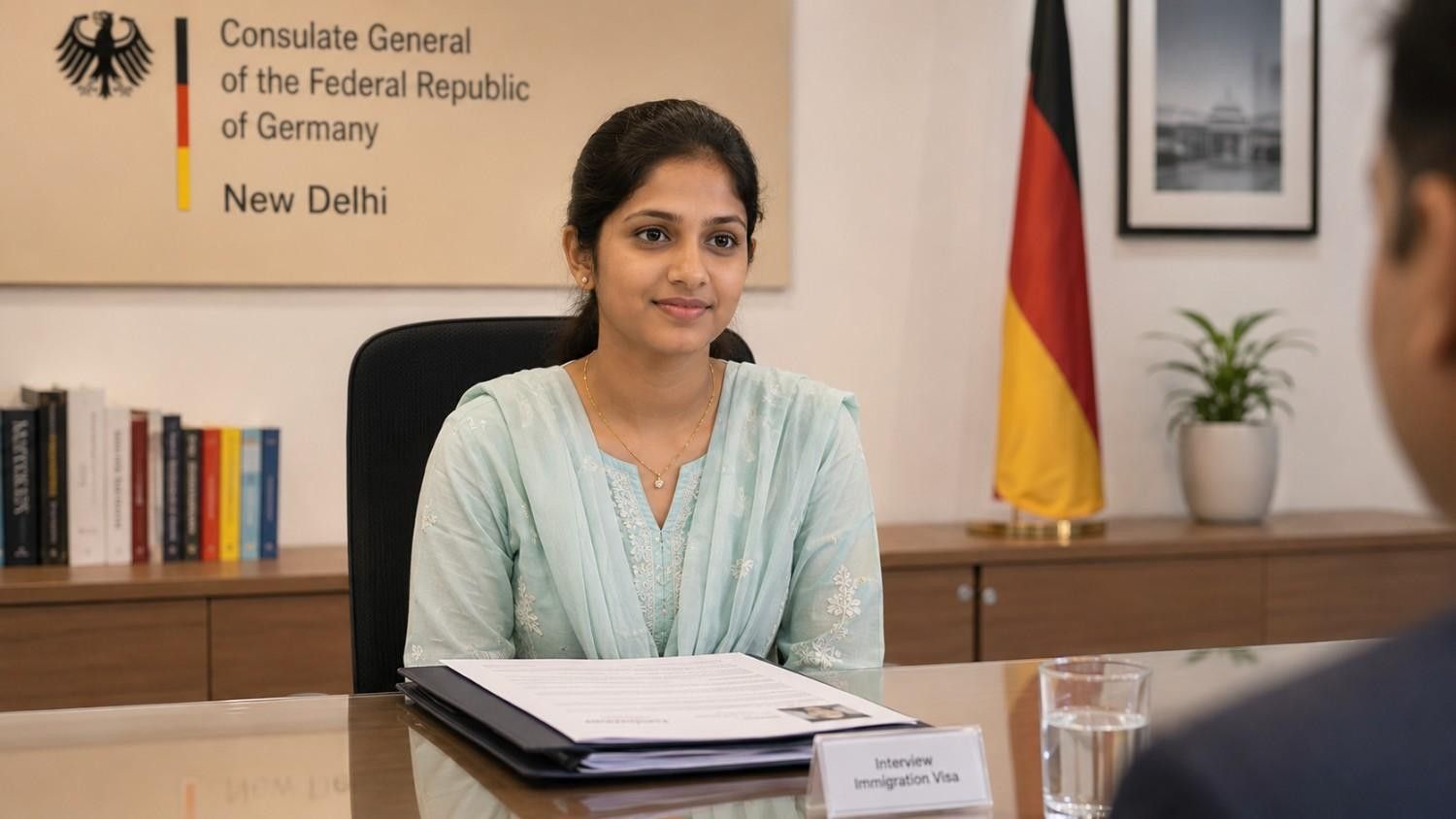
For most Indian nurses applying for the Section 16d Recognition Visa, the German consulate interview is the moment everything becomes real. You have spent months in language training, completed your B2, received your Contract of Labour, arranged your apostilled documents — and now you are sitting across from a consulate officer who will make the final call.
The good news: the consulate interview for a nursing visa is not a test of your German language skills or your nursing knowledge. It is primarily a document verification and intent assessment meeting. If your documents are in order and you are honest and clear about your purpose, the interview is straightforward. This guide tells you exactly what to prepare for.
Not always. For the Section 16d Recognition Visa, some applicants are called for a personal interview while others receive their visa after document submission without a face-to-face meeting. Whether you are called for an interview depends on the specific consulate, your application, and the consulate officer's assessment of your file.
However, you should always prepare as if an interview will happen. Being called for one and being unprepared is far worse than being prepared for one that does not occur.
India has five German consulates: New Delhi, Mumbai, Chennai, Kolkata, and Hyderabad. Your jurisdiction is determined by your state of residence in India — you must apply to the consulate that covers your home state, regardless of where you are currently living or working.
| Consulate | States Covered |
|---|---|
| New Delhi | Delhi, UP, Uttarakhand, Punjab, Haryana, HP, J&K, Rajasthan, Bihar, Jharkhand, MP, Chhattisgarh, and Northeast states |
| Mumbai | Maharashtra, Goa, Gujarat, MP (partial) |
| Chennai | Tamil Nadu, Kerala, Karnataka, Andhra Pradesh, Telangana |
| Kolkata | West Bengal, Odisha, Northeast states (partial) |
| Hyderabad | Andhra Pradesh, Telangana (check current jurisdiction — may overlap with Chennai) |
Always confirm your jurisdiction directly on the German consulate website before booking your appointment — jurisdictions are occasionally updated.
Carry originals of every document plus two sets of photocopies. Organise them in a clear folder in the order listed below — consulate officers appreciate well-organised applications.
| Document | Format to Carry |
|---|---|
| Valid passport | Original + 2 copies of data page |
| Visa application form | Completed, printed, signed |
| Passport-size photographs | 3–4, white background, recent |
| Nursing Degree Certificate | Original apostilled + certified German translation |
| Nursing Registration Certificate (INC/State Council) | Original apostilled + certified German translation |
| Academic Transcripts | Notarised + certified German translation |
| Experience Letters | Notarised + certified German translation |
| B2 Language Certificate (TELC or Goethe) | Original |
| Contract of Labour (COL) from German employer | Original + copy |
| Employer Commitment Letter | Original + copy |
| Recognition application acknowledgement | Copy |
| Bank statements (last 3–6 months) | Printed copies |
| Travel insurance (if required) | Printout |
The consulate interview for a nursing visa is not an interrogation. The officer is trying to establish that your application is genuine, that you understand what you are going to Germany to do, and that your documents match your stated purpose. These are the most common questions:
Answer in English unless asked specifically in German. Keep answers short, direct, and consistent with your documents. Do not volunteer information that was not asked for. If you do not understand a question, ask politely for it to be repeated — this is perfectly acceptable.
| Common Mistake | What to Do Instead |
|---|---|
| Giving long, over-explained answers | Answer directly and stop. Let the officer ask follow-up questions. |
| Inconsistency between answers and documents | Know your documents. Know your employer's name, city, and your job title. |
| Nervousness causing confusion | Breathe. The officer asks the same questions every day. Be calm and factual. |
| Not knowing basic German words | Practice 10–15 simple German phrases before your interview — greetings, your profession, your employer city. |
| Arriving late or underprepared | Book your appointment with buffer time. Arrive 20–30 minutes early. Review documents the night before. |
If your interview goes well and documents are complete, the officer will retain your passport and application for processing. Processing typically takes 6 to 12 weeks from the date of submission — refer to Blog #118 for the full timeline breakdown.
You may receive a request for additional documents during processing. Respond within 5 working days — delays in responding extend your total processing time. Once the visa is approved, your passport is returned by courier or in-person collection depending on the consulate.
At Jet Set Jobs, we prepare every nurse for their consulate interview as part of our placement support. We review your documents before submission, walk you through likely questions, and brief you on what to expect at your specific consulate. You will not walk into that interview room unprepared — not on our watch.
500+ nurses are currently on the Germany pathway with us. The consulate interview is one step in a well-mapped journey — and it is one we have helped many nurses navigate successfully.
📞 Book Your Free Consultation
Call / WhatsApp: +91 96259 66817
Email: support@jetsetjobs.in | www.jetsetjobs.in
500+ nurses are on their way to Germany & Austria with us. Free B2 training. Zero recruitment fees.