🛡️ Licensed by Ministry of External Affairs · RA:
B-3413/DEL/COM/1000+/5/11419/2026
📞 +91 96259 66817
📍 15, 2nd Floor, South Patel Nagar, Delhi-110008
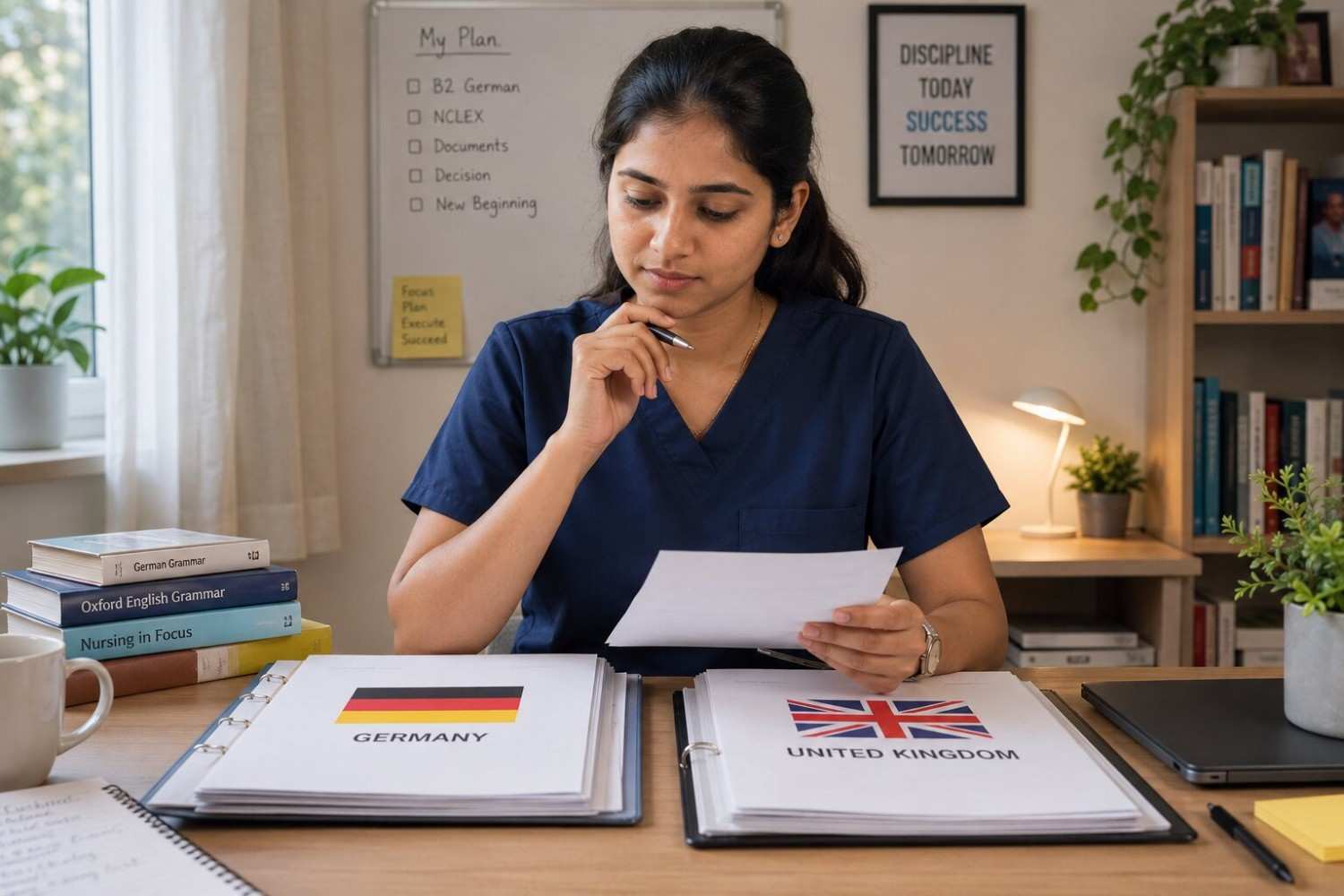
Among all the questions Indian nurses ask before committing to German language training, this one comes up repeatedly - and it deserves a serious, data-driven answer rather than a reassuring wave of the hand. The fear is legitimate: you are being asked to invest 10 to 12 months of your life learning a foreign language. What if, by the time you finish, the opportunity has closed?
This blog addresses that fear directly. We look at the structural reasons for Germany's nursing shortage, the legal and policy framework that locks Germany into international recruitment, what has happened in countries that tried to reduce international nurse hiring, and what your options are if the landscape does shift.
Germany's nursing shortage is not a temporary situation caused by a policy gap or a budget cycle. It is driven by two deeply structural, long-term demographic forces that cannot be reversed by political will.
Germany has one of the oldest populations in the world. By 2035, nearly one in three Germans will be over 60. The demand for nursing and care services grows directly with the ageing of a population - more elderly people means more hospital admissions, more care home placements, more home care requirements, and more rehabilitation needs. This demand curve does not plateau or reverse. It continues to grow for at least the next 20 to 30 years.
At the same time as demand grows, Germany's domestic working-age population is shrinking. Germany has a below-replacement birth rate and relatively low internal migration into nursing careers. Germany's own government statistics project a shortage of 500,000 healthcare workers by 2030. No domestic policy can close that gap in time.
| Year | Projected Nursing Shortage (Germany) | Key Driver |
|---|---|---|
| 2024 | ~200,000 unfilled healthcare positions | Current baseline - acute shortage already exists |
| 2027 | ~320,000 projected gap | Ageing population accelerating; domestic workforce not keeping pace |
| 2030 | ~500,000 projected gap | Government's own published projection |
| 2035 | Even higher | Peak of baby boomer generation reaching care-dependent age |
Germany does not just need nurses - it has passed laws to ensure it can recruit them internationally. The Fachkräfteeinwanderungsgesetz (Skilled Immigration Act), originally passed in 2020 and significantly strengthened in 2023 and 2024, specifically enables Germany to recruit internationally qualified healthcare workers on a structured, legally protected pathway.
This legislation was not passed casually. It was debated, refined, and passed with cross-party support because Germany's government, employers, and healthcare sector all agree: Germany cannot staff its healthcare system without international workers.
When the UK tightened its immigration rules for nurses in the mid-2010s, the NHS experienced a staffing crisis within 2 to 3 years that forced a reversal of policy. The pattern is consistent: countries with ageing populations and domestic workforce gaps cannot close international recruitment without healthcare system consequences.
Germany is aware of this pattern. Its legislation was written with long-term intent, and the government's published workforce projections make clear that international recruitment is expected to be a permanent, growing feature of the German healthcare system.
A nurse with a B2 certificate and Indian nursing qualifications can apply to hospitals and care homes across all German-speaking countries - not just Germany.
| Country | Language | Indian Nurse Demand | Pathway |
|---|---|---|---|
| Germany | German B2 | Very high - structural shortage | Section 16d visa; JSJ primary pathway |
| Austria | German B2 | High - similar demographic pressures | Red-White-Red Card; JSJ active placements |
| Switzerland | German B2 (plus French/Italian by region) | High - very high salary | Bilateral agreements; specific recruitment programmes |
| Luxembourg | German/French/Luxembourgish | Moderate - small market but open | EU freedom of movement applies |
Let us be genuinely honest: suppose Germany, for some unforeseen reason, significantly reduced international nurse recruitment for 12 to 18 months. What would happen to a nurse who has just completed B2?
The honest truth is that the worst-case scenario for a B2-certified Indian nurse is a delay of 6 to 18 months in placement, not a permanent dead end. By contrast, nurses who do not start language training at all are permanently excluded from the Germany/Austria pathway - the delay of not starting is infinite.
At Jet Set Jobs, we actively monitor the German and Austrian employer landscape on an ongoing basis. We maintain relationships with multiple verified employer partners across different German states - so if one region slows, we have options in others. We also place nurses in Austria, which provides an additional active market using the same language training.
Every nurse who completes B2 with us enters our active matching pool. We do not stop supporting you after B2 - we continue working until you have a confirmed employer match and are on your way.
500+ nurses are currently in training with us. The ones going to Germany are not gambling on a short-term trend. They are making a long-term investment in one of the most structurally secure international nursing pathways that exists. The data supports it, the legislation backs it, and the demographics guarantee it.
📞 Book Your Free Consultation
Call / WhatsApp: +91 96259 66817
Email: support@jetsetjobs.in | www.jetsetjobs.in
500+ nurses are on their way to Germany & Austria with us. Free B2 training. Zero recruitment fees.