🛡️ Licensed by Ministry of External Affairs · RA:
B-3413/DEL/COM/1000+/5/11419/2026
📞 +91 96259 66817
📍 15, 2nd Floor, South Patel Nagar, Delhi-110008
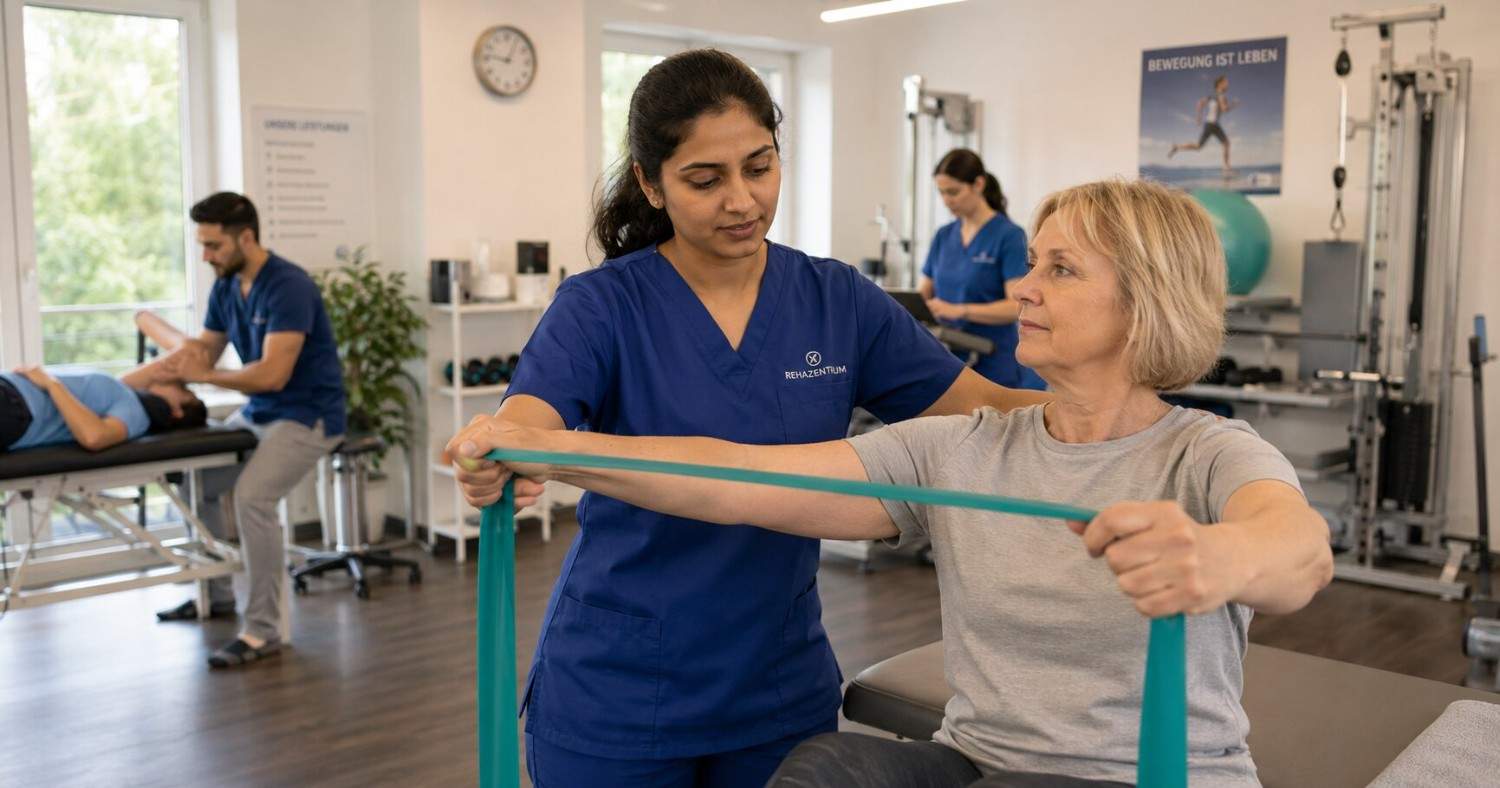
Numbers, visas, and processes tell you whether Germany is possible. But what many physiotherapists really want to know is more human: what will my actual working day feel like? Will I be respected? Will I be overworked? Will I have time for my life outside work? This blog walks through a realistic day in the life of an Indian physiotherapist working in a German hospital or rehabilitation centre - so you can picture not just the destination, but the daily reality.
Of course, every workplace differs, and your specific day will depend on your facility, your specialisation, and your role. But the broad patterns described here reflect the typical experience of physiotherapists in the German healthcare system.
German work culture values punctuality deeply, so the day starts on time. A physiotherapist working a typical day shift might begin around 7:30 or 8:00 AM. Your commute is usually short and reliable - German public transport runs precisely to schedule, or many physiotherapists in smaller cities cycle or walk to work. There is a calm predictability to the German morning that many Indians, used to unpredictable commutes, come to appreciate.
On arrival, you change into your professional attire, check your patient schedule for the day, and often begin with a brief team handover or morning meeting where the day's patients, any overnight developments, and priorities are discussed. This is conducted in German - which is exactly why the B2 language requirement matters so much. By the time you are working, your German is good enough to participate in these discussions confidently.
| Time | Activity |
|---|---|
| 7:30–8:00 AM | Arrival, change, review patient schedule, team handover |
| 8:00–10:00 AM | First patient sessions - assessments, treatment, mobility work, documentation |
| 10:00–10:15 AM | Short break (German workplaces respect scheduled breaks) |
| 10:15 AM–12:30 PM | Continued patient sessions - orthopaedic, neurological, or rehab depending on your unit |
| 12:30–1:15 PM | Lunch break - proper sit-down break, often with colleagues in the staff canteen |
| 1:15–3:30 PM | Afternoon patient sessions, group therapy, or specialised treatments |
| 3:30–4:00 PM | Documentation, team coordination, preparing for next day |
| 4:00–4:30 PM | End of shift - most day shifts finish by late afternoon |
Note the structure: defined start and end times, scheduled breaks that are genuinely taken (not skipped under pressure), and a workload that, while professional and busy, is managed rather than overwhelming. The German system places real value on not overburdening staff - both because of labour law and because of a cultural understanding that sustainable working conditions produce better care.
As a physiotherapist in Germany, your clinical work will be familiar in its fundamentals - assessment, treatment planning, manual therapy, exercise prescription, mobility work, and rehabilitation - but conducted with excellent equipment, in well-maintained facilities, and with adequate time allocated per patient. German healthcare facilities are generally well-resourced, and physiotherapists are given the time and tools to do their work properly rather than rushing through an impossible patient load.
During your adaptation period (the first 6–18 months while your recognition is being finalised), you work under the supervision of a qualified German physiotherapist. This is a supportive arrangement - you are learning the German clinical environment, refining your professional German, and demonstrating your competence. After full recognition, you practise with complete professional autonomy.
| Aspect of Work | In Germany |
|---|---|
| Time per patient | Adequate - not rushed; quality care is prioritised |
| Equipment & facilities | Well-resourced, modern, properly maintained |
| Patient load | Managed and reasonable, governed by staffing standards |
| Documentation | Thorough - done in German; part of the structured workflow |
| Team collaboration | Strong - physiotherapists work with doctors, nurses, OTs as equals |
| Professional respect | High - physiotherapists are valued members of the care team |
One of the most positive surprises for many Indian physiotherapists is the team culture in German healthcare. Hierarchies are flatter than in many Indian hospital settings - physiotherapists are treated as skilled professionals whose clinical judgement is respected, not as junior staff to be ordered around. You participate in team discussions, your input on patient care is valued, and communication between physiotherapists, doctors, and nurses is collaborative rather than top-down.
German colleagues are professional and correct, and while they may take time to become close friends (German friendships build slowly but run deep), the working relationship is respectful and supportive from the start. Many Indian physiotherapists find that as their German improves and they settle in, their colleagues become a genuine social network and source of support.
This is where the German system differs most dramatically from many Indian healthcare workplaces. When your shift ends, your work day genuinely ends. There is a strong cultural and legal respect for personal time. You are not expected to stay late routinely, take work home, or be constantly available. Overtime, where it occurs, is compensated - either paid or given back as time off.
This means that after a 4:00 or 4:30 PM finish, your evening is yours. You have time to cook, exercise, study, pursue hobbies, spend time with family, connect with the Indian community, or simply rest. For many Indian physiotherapists who came from demanding, long-hours environments, this work-life balance is genuinely life-changing - the sense that work is a part of life, not the entirety of it.
| Work-Life Factor | In Germany |
|---|---|
| Typical working hours | 38–40 hours/week, structured shifts |
| Annual leave | 28–30 days per year (by law and contract) |
| Overtime | Not routine; compensated when it occurs |
| Evenings | Generally your own - strong respect for personal time |
| Weekends | Most day-shift roles have weekends free; shift roles rotate fairly |
| Public holidays | Germany has numerous public holidays (varies by state) |
With 28–30 days of annual leave plus public holidays, German physiotherapists have substantial time off to rest, travel, and visit family. Germany's central location in Europe means weekend trips to neighbouring countries - France, Netherlands, Austria, Switzerland, the Czech Republic - are easy and affordable. Many Indian physiotherapists use their leave to explore Europe, something that would be far more difficult and expensive from India.
Annual leave is also long enough to travel back to India to see family - a two or three week trip home is entirely feasible within the German leave allowance, and many physiotherapists plan an annual visit to India around festivals or family occasions.
When you add it all together - structured working hours, adequate time per patient, well-resourced facilities, collaborative teams, professional respect, genuine work-life balance, generous leave, and a competitive salary - what emerges is a picture of a sustainable, dignified professional life. This is perhaps the most underappreciated benefit of moving to Germany as a physiotherapist: not just earning more, but working in conditions that allow you to be a good physiotherapist without burning out, and to have a full life outside of work.
For physiotherapists who love their profession but feel constrained, overworked, or undervalued in their current setting, the German working environment can be a genuine renewal - a place where the work is respected, the conditions are humane, and the career has a clear, structured future.
📞 Book Your Free Counselling Session
Call / WhatsApp: +91 96259 66817 | +91 98100 08070
Email: support@jetsetjobs.in | www.jetsetjobs.in
500+ healthcare professionals are on their way to Germany & Austria with us.
Settle Abroad with Jet Set Jobs