🛡️ Licensed by Ministry of External Affairs · RA:
B-3413/DEL/COM/1000+/5/11419/2026
📞 +91 96259 66817
📍 15, 2nd Floor, South Patel Nagar, Delhi-110008
📌 WHAT YOU'LL LEARN
Salaries and visas are one thing - but what does daily life as an Ausbildung trainee actually feel like? This blog walks you honestly through a typical day and week: the workplace, the vocational school, evenings, money, weekends, and the real emotional rhythm of building a life in Germany.
It's easy to picture the destination - a qualification, a salary, permanent residency. Much harder to picture the everyday: what you'll actually do on an ordinary Tuesday. So let's follow a typical trainee through a normal day. We'll call him Arjun - a composite of many real journeys, not one person - a 19-year-old who came from a Tier-2 Indian city and is now a first-year Ausbildung trainee in an affordable German town.
Arjun's alarm goes at around 6:30 am. Breakfast is quick - often something familiar he's learned to cook - and then a short tram ride to work on his Deutschlandticket, the €63/month pass that covers all his local transport. By 8 am he's at his workplace, changing into his work gear and greeting colleagues with a now-natural “Guten Morgen.” This is the heart of the dual system: three to four days a week, Arjun learns by doing, right on the job, alongside experienced German co-workers who show him the ropes.
The first months were daunting - every instruction in German, every tool with an unfamiliar name. But the B2 German he worked so hard for in India means he can follow along, ask questions, and slowly earn his place. Mistakes happen; his trainer treats them as part of learning, not failure. That's the German training culture: patient, structured, and genuinely invested in turning him into a skilled professional.
One or two days a week, instead of the workplace, Arjun heads to the Berufsschule - the vocational school. Here the learning is theory: the concepts behind the practical work, plus subjects like German and social studies. His classmates are a mix of Germans and other international trainees, and the classroom is where a lot of his friendships have formed. It's the part of the week that ties everything together - the “why” behind the daily “how.”
💡 WHAT “DUAL” REALLY MEANS
Arjun isn't a student who also works, or a worker who also studies - he's both at once, by design. Roughly 65–70% of his week is paid, hands-on training at the company; the rest is structured theory at the Berufsschule. That combination is exactly what makes German vocational training so respected.
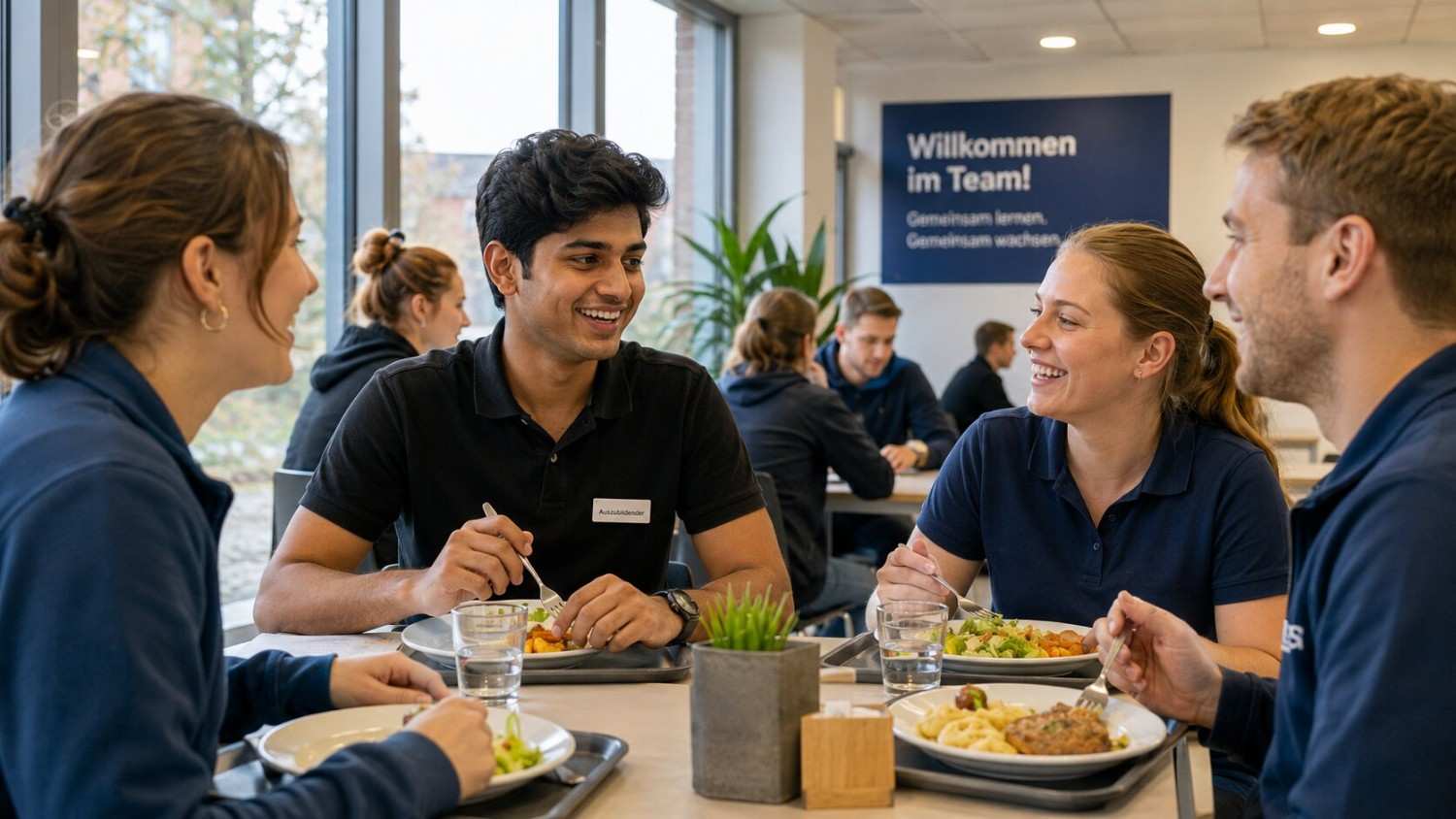
Lunch is often with colleagues in the canteen - and it's quietly one of the most valuable parts of his day. The casual chatter about weekend football, the weather, a colleague's kids, is where Arjun's German has truly come alive, far beyond what any classroom gave him. Six months in, he's stopped translating in his head and started simply talking. That shift, more than any certificate, is when Germany started to feel like home.
By late afternoon the workday ends - German working hours are respected, and overtime isn't the norm. Arjun heads home, cooks dinner (cheaper and healthier than eating out), and spends a little time reviewing German or coursework. Evenings are genuinely his: a video call home, a series, a walk, or meeting friends from his batch. The early homesickness has faded into a comfortable independence he's quietly proud of.
His stipend of around €1,000–€1,300 lands monthly. Rent for his room in a shared flat, groceries, his Deutschlandticket and phone come out of it - and in his affordable town, there's still something left to save or send home. He's not wealthy, but he's independent, earning, and building - not spending down a loan like a self-funded student would be. That difference is the whole point.
Weekends are for living. Germany's superb, affordable public transport lets Arjun explore nearby towns, castles and lakes on his Deutschlandticket for no extra cost. Sometimes he picks up a few weekend hours at a permitted side job; more often he rests, cooks with friends, plays cricket with a local Indian-origin group, or simply wanders a new neighbourhood. It's a modest life, but a full one.
Let's not romanticise it. The first few months are genuinely hard - the language tires you, the food and weather are different, and homesickness is real. Some days are repetitive, and building a new social circle from scratch takes effort. But almost every trainee describes the same arc: overwhelming at first, ordinary within months, and eventually home. The daily grind isn't glamorous - but it's steadily building a qualification, a career and a future most people only dream about.
That's what a day in the life really is: not a dramatic adventure, but a steady, dignified routine that quietly compounds. Each ordinary Tuesday is a small deposit toward a Fachkraft qualification, a good salary, permanent residency and a settled European life. As always, no one can promise a visa - but this everyday rhythm is what the whole journey is actually made of, and for the right person, it's deeply worth it.
📞 Book Your Free Consultation - Jet Set Jobs × Destination Germany
Call / WhatsApp: +91 96259 66817
Email: support@jetsetjobs.in | www.jetsetjobs.in
Ausbildung Programme Germany 2027
Eligibility: Age 18–25 | Class 12 pass | Science background preferred
Programme Fee: ₹2,50,000 + GST in 3 instalments
Free German A1–B2 training included | Stipend: €1,000–€1,300/month