🛡️ Licensed by Ministry of External Affairs · RA:
B-3413/DEL/COM/1000+/5/11419/2026
📞 +91 96259 66817
📍 15, 2nd Floor, South Patel Nagar, Delhi-110008
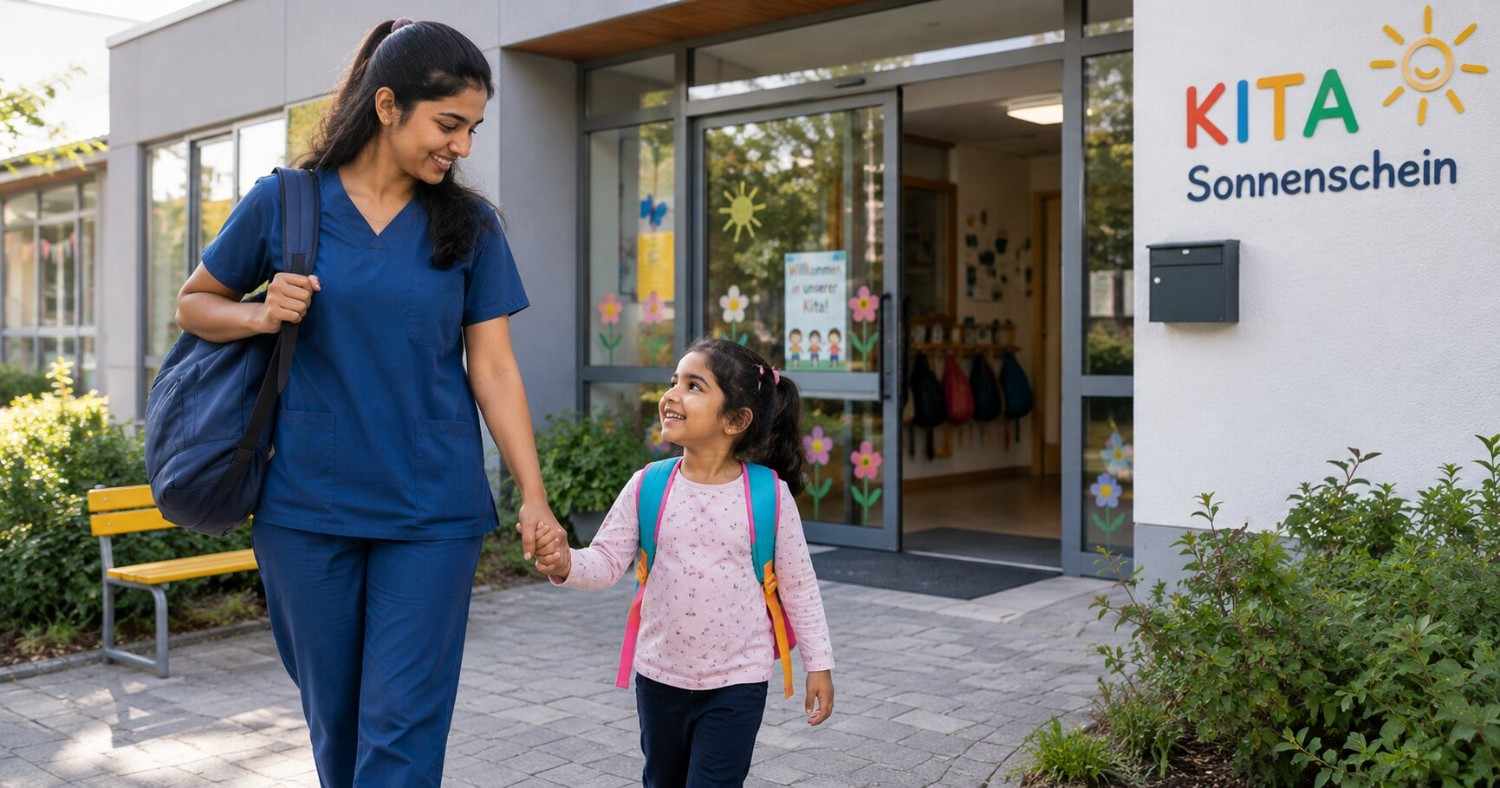
Let us start with the part that surprises most Indian parents: public school in Germany is free. School becomes compulsory (Schulpflicht) from around age 6, and the state schools charge no tuition. Textbooks are often loaned, and you pay only small amounts for things like trips or materials. Children of this age also pick up German remarkably fast - usually faster than their parents.
International or private schools do exist, and they teach in English, but they are expensive and rarely necessary. Most nurse families use the free public system, and their children settle in well within a year.
Before school age, childcare comes in two broad types: the Krippe (crèche, roughly ages 1–3) and the Kindergarten or Kita (roughly ages 3–6). Since 1 August 2013, every child in Germany has a legal right (Rechtsanspruch) to a childcare place from their first birthday - and this right does not depend on whether the parents are working. From age 3, the entitlement to a daycare or kindergarten place is even stronger.
But be honest with yourself about the catch: a legal right is not the same as a spot waiting for you on the day you want it. In cities like Berlin, Munich and Frankfurt there is a real shortage of educators and long waiting lists. So you register as early as you know your city, apply to several Kitas at once, and contact your local Jugendamt (Youth Welfare Office) for help. If a spot is genuinely denied, parents can even take the matter further - but it is far easier to simply apply early and widely.
One more thing to plan for: the Eingewöhnung (settling-in period). For the first two to six weeks, a parent usually has to be present at the Kita while the child slowly bonds with the educators. Do not schedule your return to work for the exact day the Kita starts - build this month into your plans.
There is good news coming for working parents too. From August 2026, every child in Grade 1 has a legal right to all-day care at primary school, and this is being extended year by year until all of Grades 1 to 4 are covered by August 2029. That makes balancing shift work and school far more manageable.
Childcare fees vary enormously depending on which state you live in, and often on your income:
| State / City | Rough Kita cost | Note |
|---|---|---|
| Berlin, Mecklenburg-Vorpommern | Free tuition | Small food fee, e.g. ~€23/month |
| Many other states | €0 to €1,000+/month | Often based on income |
| Cologne, Frankfurt, Munich | Among the highest | Private centres cost more |
| Childminder (Tagesmutter) | ~€3–€25 per hour | Varies by area and hours |
Because the rules differ so much, always confirm your own state's fees with the local Jugendamt rather than assuming. Low-income families and those on certain benefits are often exempt from fees altogether.
Here is the structure in plain terms:
| Stage | German name | Age | Notes |
|---|---|---|---|
| Nursery | Krippe | ~1–3 | Optional childcare |
| Kindergarten | Kindergarten / Kita | 3–6 | Optional, prepares for school |
| Primary | Grundschule | 6–10 (Grades 1–4) | Compulsory and free |
| Secondary | Gymnasium / Realschule / Hauptschule / Gesamtschule | 10+ | Tracked by ability and interest |
The part that often surprises Indian parents is the early tracking at around age 10, when children move into different secondary school types. Gymnasium leads towards the Abitur and university; the others lead towards strong vocational and technical paths. It feels early, but it is not fixed forever - children can and do switch tracks later.
Germany pays a universal child benefit called Kindergeld, regardless of your income. From January 2026 it is €259 per child per month (up from €255 in 2025), paid directly into your bank account until the child turns 18 - or up to 25 if they are still studying or in training. You apply to the Familienkasse, and you will need tax ID numbers for yourself and your child.
One honest warning: Kindergeld is only backdated up to six months, so apply as soon as you arrive and have your paperwork - money for earlier months is simply lost. A separate parental-allowance scheme (Elterngeld) also exists, though it has income limits for higher earners, so treat the details as something to confirm for your own situation.
📞 Book Your Free Consultation
Call / WhatsApp: +91 96259 66817
Email: support@jetsetjobs.in | www.jetsetjobs.in
500+ nurses are on their way to Germany & Austria with us. Free B2 training. Zero recruitment fees.