🛡️ Licensed by Ministry of External Affairs · RA:
B-3413/DEL/COM/1000+/5/11419/2026
📞 +91 96259 66817
📍 15, 2nd Floor, South Patel Nagar, Delhi-110008
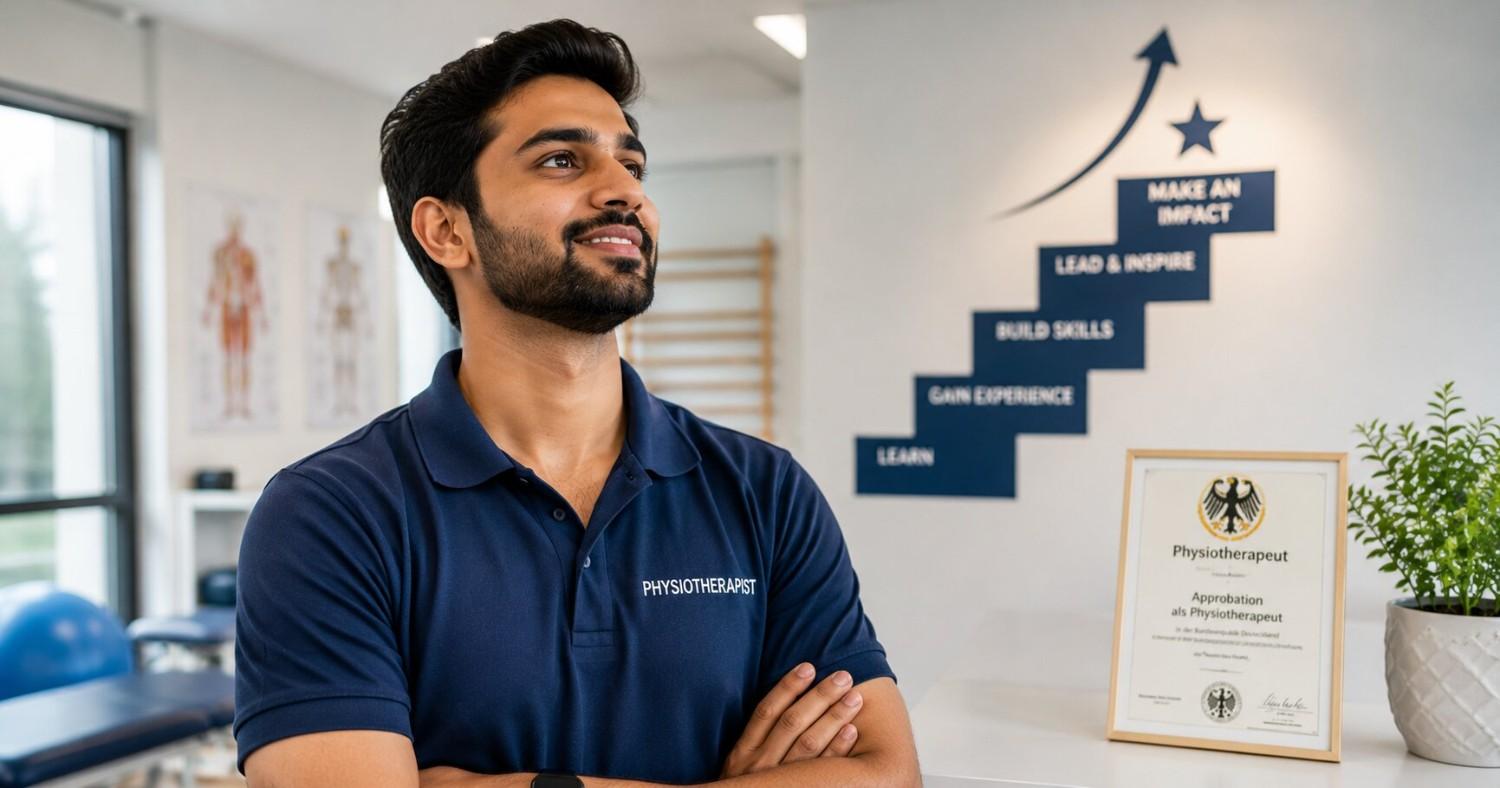
A common question from physiotherapists planning a German career is: where does this actually go? Nobody wants to move abroad only to stay on an entry salary forever. The good news is that physiotherapy pay in Germany grows in a fairly predictable way - through experience, through automatic pay steps on collective scales, and through specialisation and responsibility.
This blog maps the indicative 2026 salary journey from your first day as a licensed physiotherapist to a senior or leadership role, and shows the fastest levers to climb. Every figure is indicative and gross; your real path depends on your employer, state and the choices you make along the way.
Here is the broad shape of a physiotherapist's earnings across a career in 2026. These are indicative gross monthly figures drawn from public salary data - individual pay varies with employer, region and qualifications.
| Career stage | Indicative gross / month | Typical timing |
|---|---|---|
| Entry level (newly licensed) | ~€2,700 – €3,000 | Year 1–2 |
| Established (a few years in) | ~€3,000 – €3,300 | ~3–5 years |
| Experienced | ~€3,300 – €3,700 | ~5–10 years |
| Senior / specialised | ~€3,700 – €4,200 | ~10+ years or with certificates |
| Leadership (team / department lead) | ~€3,800 – €4,500+ | With responsibility |
If you work for a tariff-bound employer - a public hospital, a church-run provider, many rehab clinics - your growth is partly automatic. Under the TVöD, physiotherapists are usually placed around entry group 7, which is divided into experience "steps" (Stufen). You start on step 1 and move up: to step 2 after one year, step 3 after two more, and so on, reaching the top step after roughly fifteen years of service. On the TVöD-P scale, that journey runs indicatively from about €3,200 at the entry step to around €4,000 at the top - before any promotion or specialisation. In other words, simply staying and gaining experience raises your pay on a fixed schedule, and the tables themselves rose by 2.8% from May 2026.
Experience alone lifts your pay steadily, but three levers speed it up:
The distance between a newly licensed physiotherapist (around €2,700–€3,000) and an experienced or specialised one (€3,700–€4,200+) is significant - often €1,000 or more a month - but it is a path, not a leap. Unlike many careers where raises depend on negotiation, a large part of physiotherapy growth in the public and church sectors is built into the pay scale. Add a specialisation or step into leadership, and the ceiling rises further. For anyone planning a long-term career, that predictability is a real strength.
For candidates on our pathway, this is the encouraging long view. You typically begin at an indicative €2,800–€3,200 gross per month around recognition, move to roughly €3,200–€3,800 once fully licensed, and then climb from there through experience, tariff steps, specialisation and responsibility. These are indicative figures, not guarantees, but the direction is clear and largely structural. Our counsellors help you choose first roles and specialisations that set up the steepest, most sustainable growth - so your German career keeps building, not plateauing.
📞 Book Your Free Counselling Session
Call / WhatsApp: +91 96259 66817 | +91 98100 08070
Email: support@jetsetjobs.in | www.jetsetjobs.in
500+ healthcare professionals are on their way to Germany & Austria with us.
Settle Abroad with Jet Set Jobs