🛡️ Licensed by Ministry of External Affairs · RA:
B-3413/DEL/COM/1000+/5/11419/2026
📞 +91 96259 66817
📍 15, 2nd Floor, South Patel Nagar, Delhi-110008
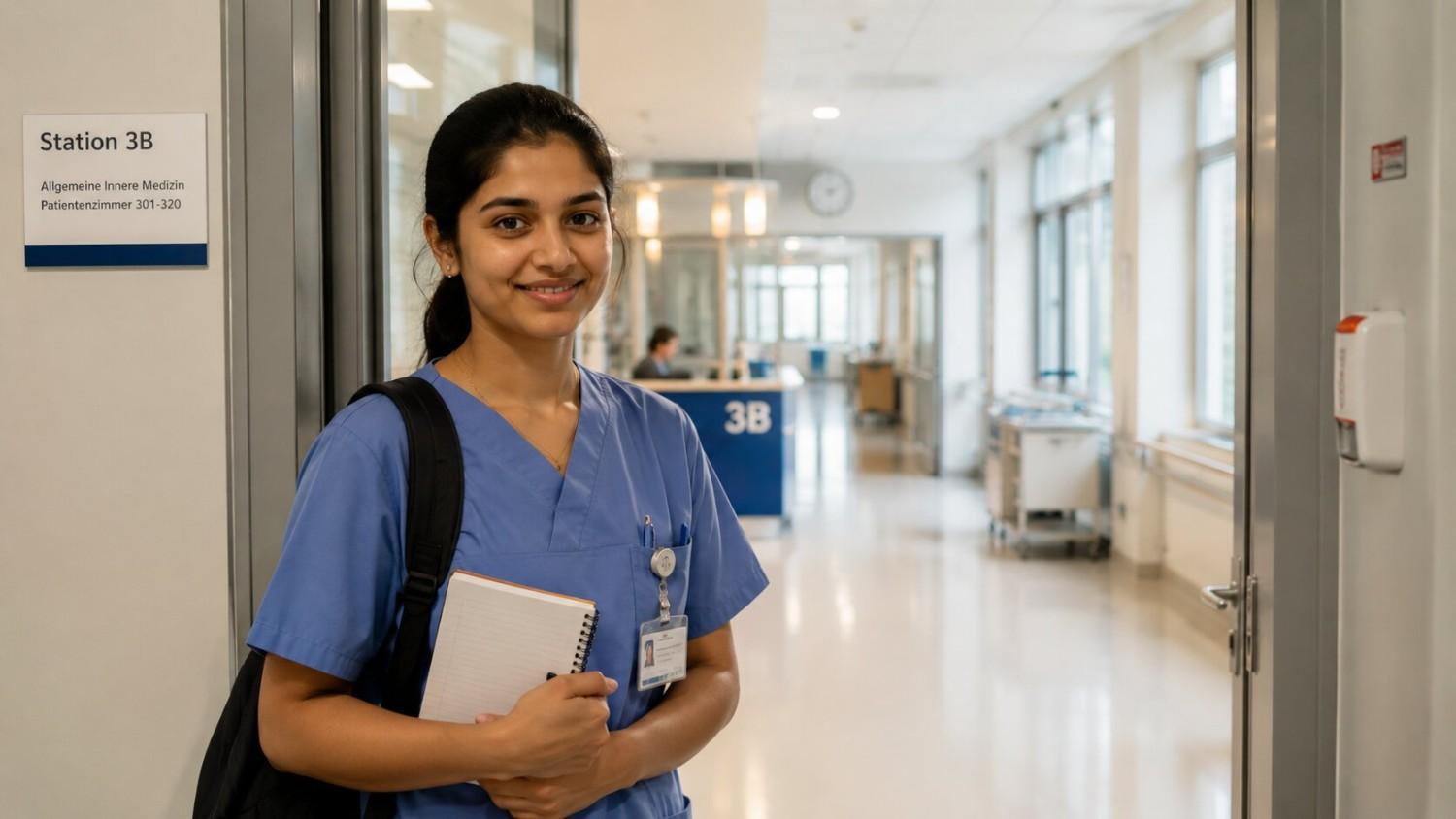
Germany runs on punctuality, and hospitals most of all. The unwritten rule is that five minutes early is "on time", and arriving exactly on the hour is almost late. On your first day, come earlier still - find the ward, the changing room and your locker before the shift begins. Being reliably punctual is one of the fastest ways to earn your new colleagues' trust.
German wards run on a rotating three-shift system. You will not do all three at once, but you should know them from day one:
| Shift | German name | Rough hours |
|---|---|---|
| Early | Frühdienst | ~06:00 – 14:00 |
| Late | Spätdienst | ~14:00 – 22:00 |
| Night | Nachtdienst | ~22:00 – 06:00 |
Exact times vary by hospital, and every shift begins and ends with a handover. Early shifts are the busiest - morning care, medications, doctors' rounds - so your first Frühdienst will feel like a lot. That is expected.
At the start and end of each shift, the team going off duty hands each patient over to the team coming on. This is the Übergabe, and it is the single most important routine on the ward - it is where you learn who your patients are, what happened, and what needs watching. It is spoken quickly and in German, and it is also documented. On day one you will not catch everything; bring a small notebook, write down room numbers and key points, and ask afterwards. Nobody expects perfection at your first handover.
A few people matter most early on. Your Stationsleitung (ward manager) runs the ward and is your main point of contact. Your Praxisanleiter (practice mentor) is assigned to guide you, show you routines and answer questions - lean on them. Your nursing colleagues will show you where things are, and the Stationsarzt (ward doctor) is the doctor you will interact with most. Introduce yourself, and use the formal "Sie" with everyone until you are invited to use first names.
Be ready for this one: Germany documents everything. Every observation, every medication, every care action is written down, in German, in detail. Many nurses are surprised that a large share of the shift goes on documentation rather than hands-on care. It feels heavy at first, but it exists to protect both you and the patient - accurate records are how German wards keep care safe and accountable.
For the first weeks you will feel slow. You will say "Wie bitte?" (pardon?) many times, ask colleagues to repeat things, and go home tired. This is normal, and your colleagues know you are new and new to the language. In Germany, asking to confirm is seen as responsible, not weak - checking a dose or a name is professional behaviour, not a failure. Give yourself a few weeks; almost every nurse describes the fog lifting by month two or three.
📞 Book Your Free Consultation
Call / WhatsApp: +91 96259 66817
Email: support@jetsetjobs.in | www.jetsetjobs.in
500+ nurses are on their way to Germany & Austria with us. Free B2 training. Zero recruitment fees.