🛡️ Licensed by Ministry of External Affairs · RA:
B-3413/DEL/COM/1000+/5/11419/2026
📞 +91 96259 66817
📍 15, 2nd Floor, South Patel Nagar, Delhi-110008
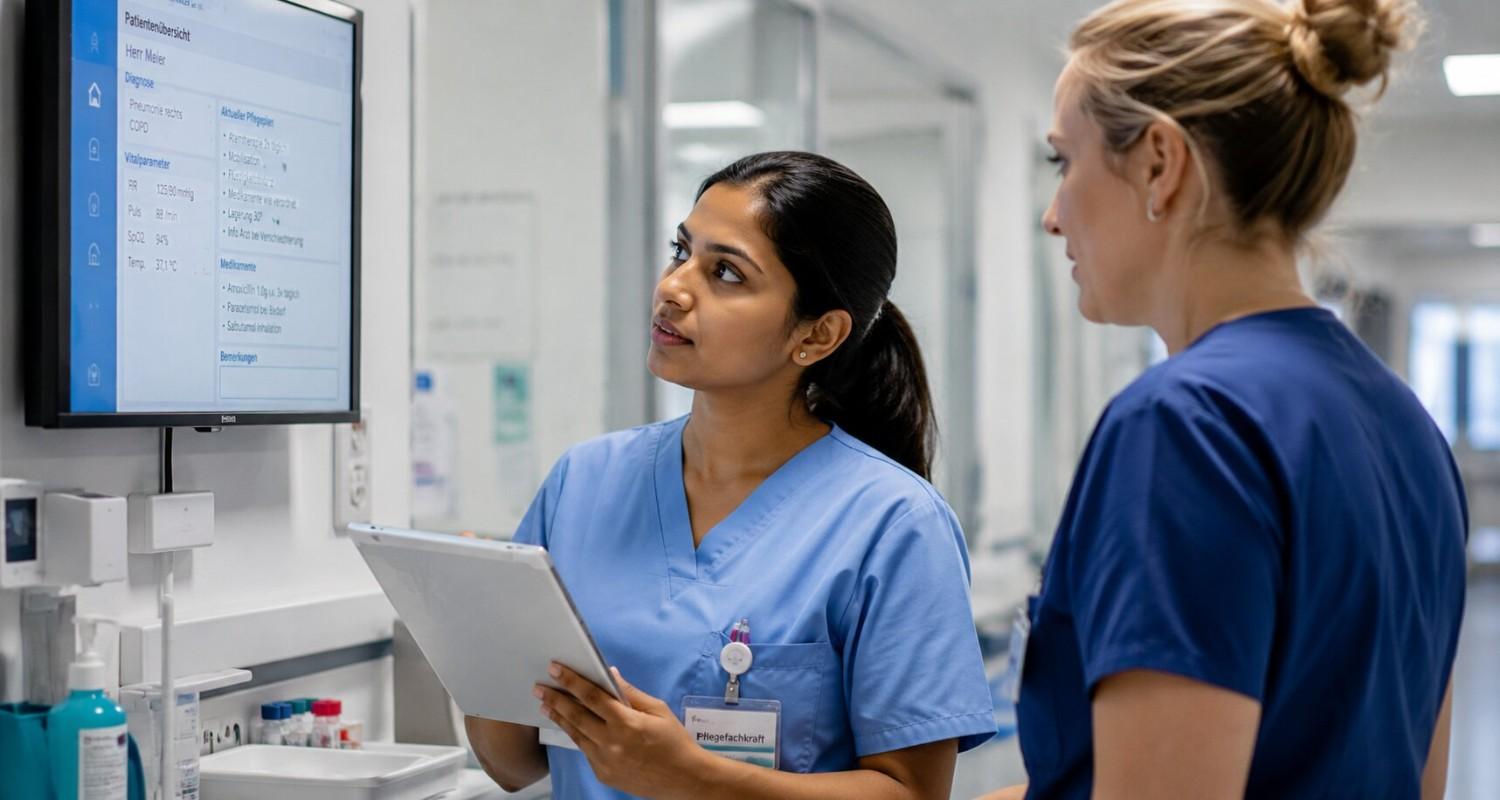
This one catches almost every Indian nurse off guard. In many German hospitals, tasks such as venous blood draws (Blutentnahme) and inserting IV cannulas (Venenverweilkanüle) are traditionally carried out by doctors, not nurses — the opposite of what you are used to. Physical examinations, ordering tests and prescribing are also physician tasks. This is slowly changing and varies by hospital — some delegate these to specially trained nurses — but do not assume you will be doing your own bloods and IVs from day one.
German nursing splits care into two clear categories, and you will hear these words constantly:
| Term | Meaning | Typical examples |
|---|---|---|
| Grundpflege | Basic care | Washing, mobilising, feeding, positioning, hygiene |
| Behandlungspflege | Treatment care | Medication, wound care, injections (as delegated), monitoring |
You will do a great deal of hands-on Grundpflege yourself — often more than Indian nurses expect. This is considered core, dignified nursing in Germany, not a lesser task, and it is a central part of your day.
German healthcare runs on a delegation model. Many medical tasks are performed by nurses only when delegated by a physician, who remains legally accountable. Independent, advanced nursing practice — nurses ordering tests or prescribing — is still developing in Germany and is far less common than in India, the UK or the US. In practice this means you may have less independent clinical authority in some areas, and more clearly structured, delegated responsibility in others.
Expect to spend a meaningful share of every shift on documentation. Every observation, medication and care action is recorded, in German, in detail. It can feel like a lot at first, especially in a new language, but it is a genuine and non-negotiable part of the German nurse's job — not an afterthought squeezed in around "real" nursing.
In many Indian settings, a patient's family does a lot at the bedside — feeding, washing, watching over them. In Germany, the nursing team does this care. Families visit, but they do not usually provide daily bedside care. The practical result is that you personally do more of the hands-on basic care than you might in India, where some of it is shared with relatives.
It is easy to feel, in the first weeks, that your role has shrunk because you are not doing procedures you used to do. Reframe it honestly: you may do fewer invasive procedures but more holistic care, documentation and coordination. Many Indian nurses come to genuinely value the German emphasis on dignity, thoroughness and the whole patient. Your skills are not wasted — they are redistributed.
📞 Book Your Free Consultation
Call / WhatsApp: +91 96259 66817
Email: support@jetsetjobs.in | www.jetsetjobs.in
500+ nurses are on their way to Germany & Austria with us. Free B2 training. Zero recruitment fees.