🛡️ Licensed by Ministry of External Affairs · RA:
B-3413/DEL/COM/1000+/5/11419/2026
📞 +91 96259 66817
📍 15, 2nd Floor, South Patel Nagar, Delhi-110008
📌 WHAT YOU'LL LEARN
Why electrical is one of Germany's hottest, most future-proof trades right now, the main Elektroniker Ausbildung tracks and what each involves, and whether it fits a Science student - with what it pays and the honest realities.
If you want a trade with genuine long-term demand, electrical is hard to beat. Germany's Energiewende (energy transition), the rollout of EV charging, building renovation and industrial modernisation are all happening at once - and every one of them needs skilled electrical workers. The Federal Employment Agency classes electricians as a Mangelberuf, an official shortage occupation, which means qualified people hold real bargaining power over pay and conditions.
For an aspirant, that translates into something simple: strong job security, solid pay, and a skill that isn't going to be automated or offshored away.
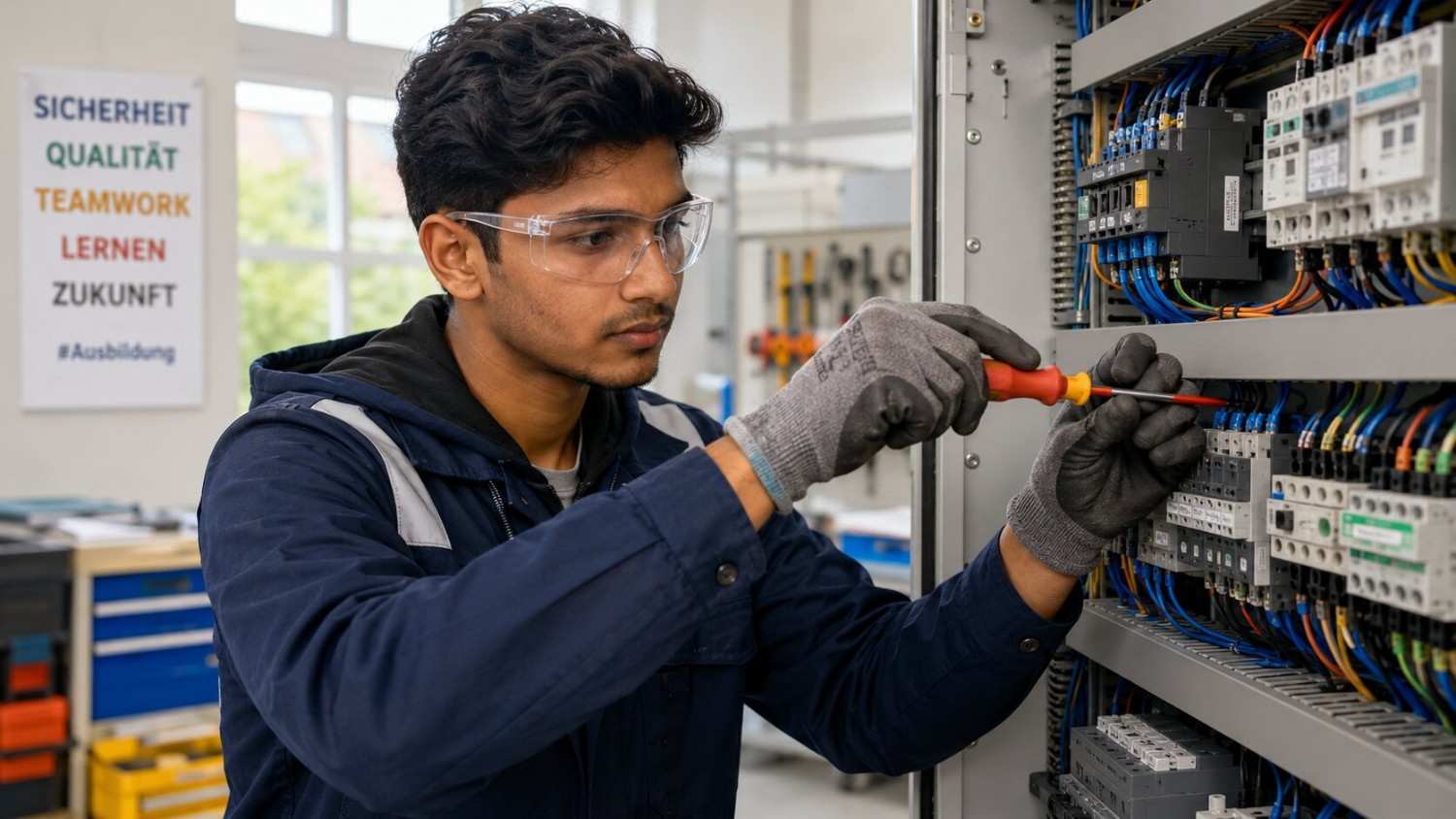
An Elektroniker installs, maintains, repairs and troubleshoots electrical systems - from factory automation and control panels to building power, energy technology and modern smart systems. It's hands-on, problem-solving work: finding faults, wiring and testing installations, and keeping critical systems running safely. If you liked the practical, logical side of physics, this is a trade that rewards it every day.
Electrical isn't one job - it's a family of specialisations. The main German tracks include:
| Track | What you'd focus on |
|---|---|
| Betriebstechnik (industrial/operational) | Powering and maintaining factories, machines and industrial plants. |
| Energie- und Gebäudetechnik (energy & building) | Wiring, power and energy systems for buildings and homes. |
| Automatisierungstechnik (automation) | Control systems and automated production - close to mechatronics. |
| Geräte und Systeme (devices & systems) | Building and servicing electronic devices and equipment. |
The exact track depends on the employer you're matched with, but all share the same strong-demand foundation - and all are three-year, paid Ausbildung roles.
Yes - arguably better than almost any trade. A background in physics and maths maps directly onto electrical theory, circuits and problem-solving. You don't need prior electrical experience; you learn the trade during the Ausbildung itself. What helps most is a logical mind, care with detail (safety matters), and genuine interest in how things work.
Electrical is one of the better-paying trades. A qualified Fachkraft typically earns €3,000–€4,000+ gross a month to start, and high-demand specialisations - industrial automation, high-voltage systems, photovoltaics - push meaningfully higher. Earn a Meister and you can add roughly €10,000–€20,000 a year, unlocking supervisory roles or even running your own electrical business. With the Energiewende driving demand for years to come, the long-term outlook is strong.
⚠️ THE HONEST PART
It's a real, hands-on trade - sometimes physical, occasionally with shift work, and always demanding care because you're working with electricity and safety rules. It needs B2 German (10–12 months with us), and as with every route, the employer selects you independently and no seat or visa is guaranteed. But few trades combine this level of demand, security and pay so well.
Do I need any electrical background to start?
No. You learn the trade from the ground up during your three-year Ausbildung, both on the job and at vocational school. A Science background helps with the theory, but the practical skills are taught to you. Curiosity and care matter more than prior experience.
Is electrical work safe as a career choice?
In terms of demand, it's one of the most secure trades in Germany - an official shortage occupation with strong long-term drivers. On the job, safety is taken extremely seriously and you're trained thoroughly in it. It's a stable, future-proof path.
Can this lead somewhere bigger than a technician role?
Absolutely. With a Meister or Techniker you can move into supervision, project work or self-employment, and the vocational route can even open a university degree later. Electrical is a career with a long ladder, not a ceiling.
583+ aspirants have already started their Germany journey with Jet Set Jobs and Destination Germany.
📞 Book Your Free Consultation - Jet Set Jobs × Destination Germany
Call / WhatsApp: +91 96259 66817
Email: support@jetsetjobs.in | www.jetsetjobs.in
Ausbildung Programme Germany 2027
Eligibility: Age 18–25 | Class 12 pass | Science background preferred
Programme Fee: ₹2,50,000 + GST in 3 instalments
Free German A1–B2 training included | Stipend: €1,000–€1,300/month