🛡️ Licensed by Ministry of External Affairs · RA:
B-3413/DEL/COM/1000+/5/11419/2026
📞 +91 96259 66817
📍 15, 2nd Floor, South Patel Nagar, Delhi-110008
 JET SET JOBS
Settle Abroad with Jet Set Jobs
JET SET JOBS
Settle Abroad with Jet Set Jobs
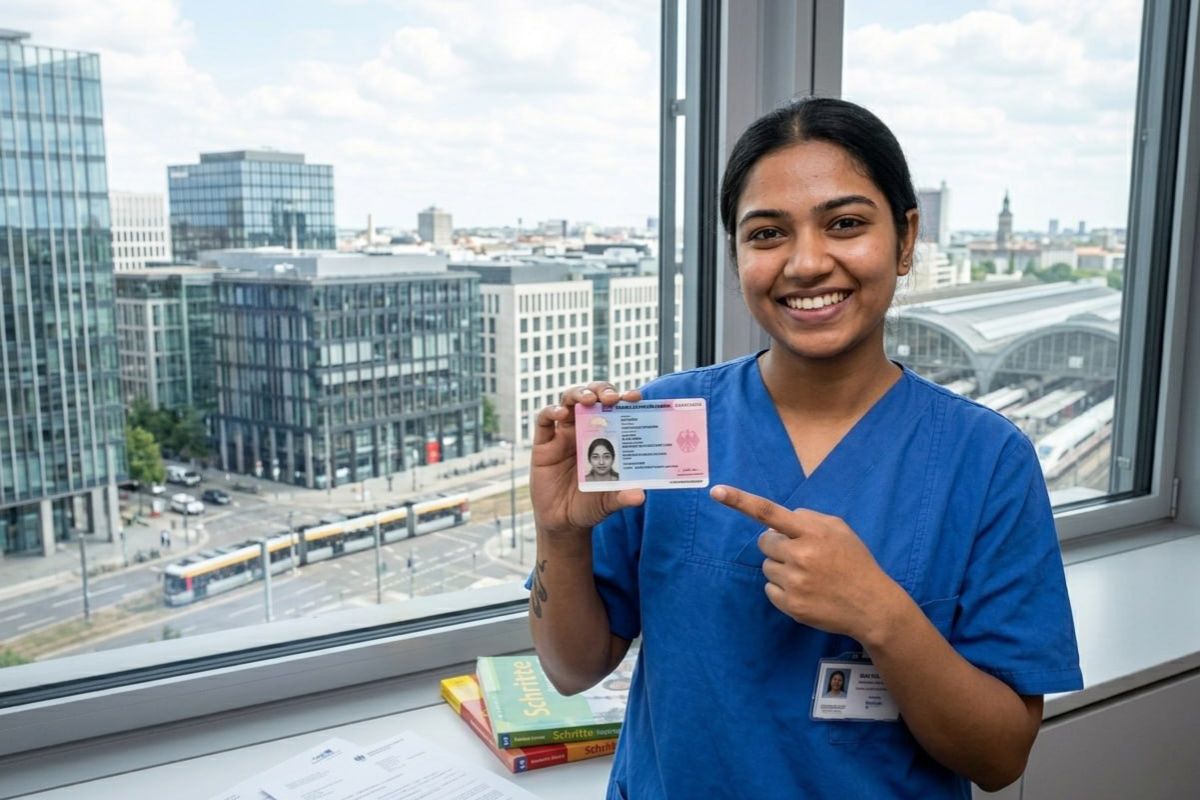
🎯 Germany offers one of the most accessible paths to permanent residency in Europe – and nurses on Skilled Worker Visas are in a strong position to qualify. This guide explains the full PR process for Indian nurses.
Working in Germany is the goal most Indian nurses start with. But many discover that Germany also offers something more valuable in the long run – a clear, structured pathway to permanent residency and, eventually, German citizenship. Understanding this pathway early helps you plan your career and finances in Germany with a long-term perspective.
The Niederlassungserlaubnis (NE) is Germany’s permanent settlement permit. Unlike your initial Skilled Worker Visa – which is tied to a specific employer and must be renewed – the NE:
Skilled workers (including nurses) on a Fachkräftevisum can apply for the Niederlassungserlaubnis after 4 years of continuous legal residence and employment in Germany. In some cases – particularly for highly integrated individuals – the waiting period can be reduced to 2 years under special circumstances.
There is also an EU Blue Card route available to nurses in some situations (where salary thresholds are met) – this allows PR application after just 21–33 months.
| Requirement | Detail |
|---|---|
| Residence in Germany | Minimum 4 years of continuous legal residence on a valid permit |
| Employment | Continuous employment throughout the residence period – as a nurse |
| German language | B1 level minimum (note: you will already have B2 – this is easily met) |
| Pension contributions | Minimum 48 months of contributions to the German pension system |
| Financial stability | Sufficient income to support yourself without social welfare assistance |
| No criminal record | Clean criminal record in Germany |
| Integration | Basic knowledge of Germany’s legal system, society, and living conditions (assessed in an interview) |
| Timeline | What Happens |
|---|---|
| Year 1–2 | Arrive, begin work, complete recognition, settle in Germany |
| Year 2–3 | Family reunification if applicable; establish stable housing and income |
| Year 3–4 | Continue employment; maintain pension contributions; improve German language beyond B2 |
| Year 4 | Apply for Niederlassungserlaubnis – submit documents to Ausländerbehörde |
| Year 4 (after approval) | Receive permanent settlement permit – no more visa renewals |
| Year 8 | Eligible for German citizenship (naturalisation) – can hold dual citizenship in some cases |
No – permanent residency does not mean you are permanently bound to Germany. You can visit India as often as you wish. However, to maintain your NE you must not be absent from Germany for more than 6 consecutive months (or 12 months in exceptional circumstances with prior approval). If you are absent longer, the NE lapses.
After 8 years of legal residence in Germany (reducible to 5–6 years with exceptional integration), you can apply for German citizenship. Germany generally requires you to give up Indian citizenship (dual citizenship is not automatically available) – though exceptions are increasingly being made under recent German citizenship law reforms.
German citizenship gives you full EU citizenship – meaning you can live and work in any EU country. For many Indian nurses, this is the ultimate long-term goal.
📞 Book Your Free Consultation – Call / WhatsApp: / +91 96259 66817 Email: support@jetsetjobs.in Website: Jet Set Jobs.in 583+ nurses have started their journey to Germany & Austria. Free B2 training. Zero recruitment fees.
Book a free demo class at our Karol Bagh centre or attend online. No commitment. No fees. Just one hour that could change your career.
Karol Bagh, New Delhi – 110008