🛡️ Licensed by Ministry of External Affairs · RA:
B-3413/DEL/COM/1000+/5/11419/2026
📞 +91 96259 66817
📍 15, 2nd Floor, South Patel Nagar, Delhi-110008
 JET SET JOBS
Settle Abroad with Jet Set Jobs
JET SET JOBS
Settle Abroad with Jet Set Jobs
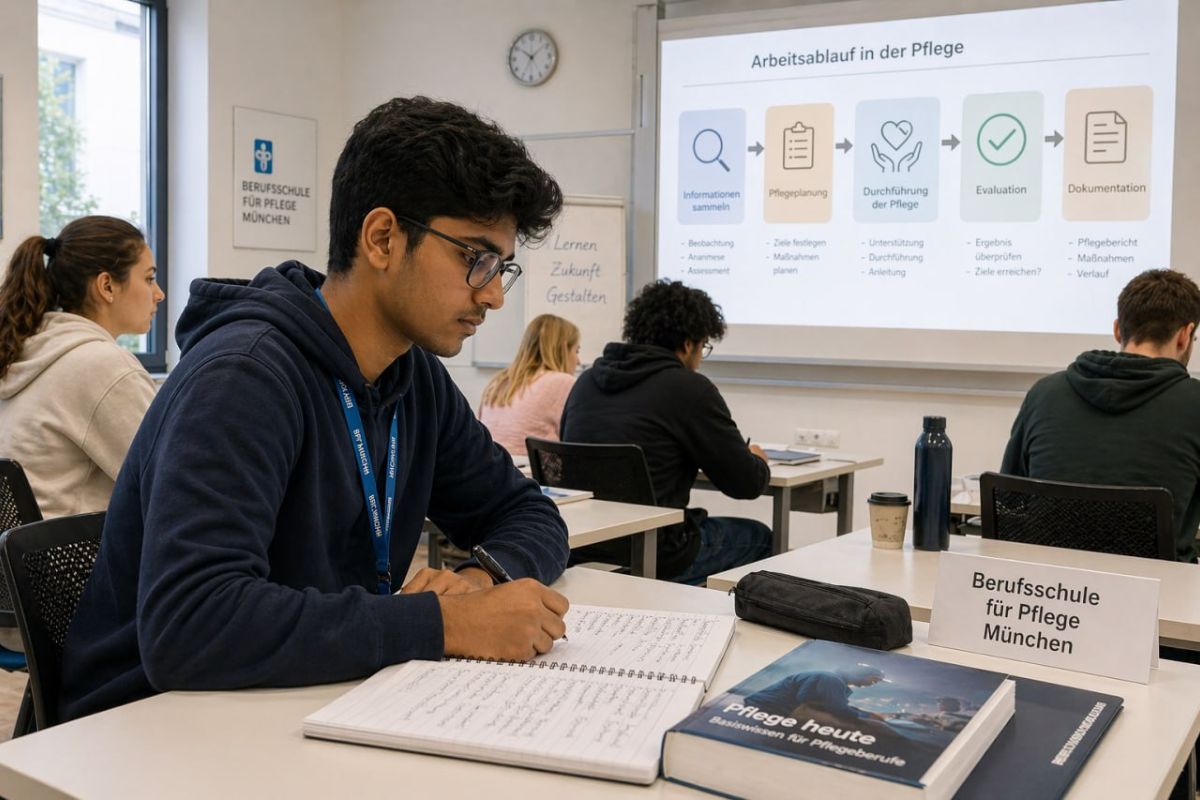
💡 In this blog: A complete explanation of the Berufsschule – Germany’s vocational school – what it is, what you study there, how it fits into the Ausbildung dual system, and what the experience is actually like for Indian students from Class 12.
When you do Ausbildung in Germany, you do not spend all your time at your training employer. Four days a week you are at work – but one day per week, you attend Berufsschule. For Indian students who have just come from a Class 12 Indian school system, the Berufsschule is often one of the most surprising and interesting parts of the Ausbildung experience.
This blog explains exactly what Berufsschule is, how it is structured, what subjects you study, how it compares to Indian schooling, and what you can do to prepare for it before you arrive in Germany.
Berufsschule (pronounced ‘be-ROOFS-shoo-le’) translates directly as ‘vocational school.’ It is the educational half of Germany’s dual training system – the Ausbildung. While your employer provides the practical, hands-on learning, the Berufsschule provides the theoretical and professional foundation: the science, the regulations, the ethics, the documentation, and the professional communication skills behind the work you do every day.
Every Ausbildung trainee in Germany attends Berufsschule. You are not doing this alone – you will be in a class with other trainees (called Azubis) from various employers in your region, all studying the same Ausbildung track. Some of your classmates will be German. Some will be from other countries. The class size is typically 15–25 students.
Berufsschule is government-run and completely free. There are no tuition fees, no examination registration fees, and no materials costs beyond basic stationery. It is part of your Ausbildung by law – your employer is obligated to give you the day off to attend.
| Component | Where | Days/Week | What You Learn |
|---|---|---|---|
| Praktische Ausbildung (Practical Training) | Your employer – hospital, care facility, etc. | 4 days | Hands-on skills, real work, supervised practice |
| Berufsschule (Vocational School) | Government school in your region | 1 days | Theory, professional regulations, documentation, ethics, professional German |
The two components complement each other directly. What you learn in theory on Wednesday at the Berufsschule, you apply in practice on Thursday back at your employer. This tight link between theory and practice is one of the reasons the German dual system produces such high-quality trained professionals – and why German vocational qualifications are respected worldwide.
The specific subjects depend on your Ausbildung field. For candidates in the care and social services sector – which is the primary track in the JSJ programme – the Berufsschule curriculum typically covers the following areas:
The depth of these subjects increases across the three years of Ausbildung. In Year 1, you are building foundational knowledge. In Year 2, you go deeper into specialisation. In Year 3, you are preparing for the state examination, which tests both your practical competence and your theoretical knowledge across all the subjects above.
Indian students who have come through the Class 12 CBSE or state board system will notice both similarities and differences in the Berufsschule environment. The classroom format – a teacher at the front, desks in rows, written notes and assessments – is familiar. What is different is the teaching style and the purpose.
Berufsschule teachers (called Berufsschullehrer) are typically qualified professionals with real-world experience in the field they teach, not just academic instructors. Classes are practical and applied – the goal is not to pass an academic exam for its own sake, but to build professional competence that directly translates to your workplace. You will spend a significant amount of class time in case studies, role plays, group problem-solving, and practical demonstrations.
The assessment model is also different. You will have regular written tests (Klassenarbeiten) and practical assessments throughout the three years, but there is no equivalent of an annual board exam every year. The major exam is the Abschlussprüfung (final state examination) at the end of Year 3, which is jointly organised by your Berufsschule, your employer, and the relevant state examination board.
Everything at the Berufsschule is in German. The teacher speaks German. The textbooks are in German. The written tests are in German. This is one of the most important reasons JSJ insists on a genuine B2 before candidates arrive – because on your first day of Berufsschule, you need to be able to follow a lesson, take notes, and ask questions, all in a foreign language in an entirely new academic context.
The good news is that Berufsschule teachers who work with international Azubis are accustomed to supporting students who are still developing their German. Many Berufsschulen provide additional German language support classes for international students. Your classmates – many of whom will be from different countries – become a natural study group. And the vocabulary of your specific professional field is relatively consistent and learnable, because it is used in exactly the same contexts day after day.
Students who arrive at B2 German find the first Berufsschule term manageable. Arriving at B2 is the standard JSJ trains every candidate to. This is the practical reason – beyond the visa requirement – why JSJ pushes for genuine language preparation before departure.
Attendance at Berufsschule is compulsory. Your employer is legally required to give you the day to attend, and you are legally required to attend. Missing classes without a valid reason can lead to warnings and, in serious cases, affect your training contract. If you are unwell, you follow the same sick-leave rules as for work – inform both your employer and your Berufsschule on the same day.
Your Berufsschule grades (called Noten, on a scale of 1–6 where 1 is excellent and 6 is fail) form part of your overall Ausbildung assessment. At the end of Year 3, the Abschlussprüfung is split into a written section (at the Berufsschule) and a practical section (at your employer). Both must be passed. On passing, you receive your Ausbildungsabschluss – the German government-certified professional qualification that validates your three years of training.
📞 Book Your Free Consultation – Jet Set Jobs × Destination Germany
Call /
WhatsApp: +91
96259 66817
support@jetsetjobs.in | www.jetsetjobs.in
Ausbildung Programme Germany 2027
Eligibility: Age 18–25 | Class 12 pass | Science background preferred
Programme fee: ₹2,50,000 + GST in 3 instalments
Free German A1–B2 training included | Stipend: €1,000–€1,300/month in Germany
Book a free demo class at our Karol Bagh centre or attend online. No commitment. No fees. Just one hour that could change your career.
Karol Bagh, New Delhi – 110008