🛡️ Licensed by Ministry of External Affairs · RA:
B-3413/DEL/COM/1000+/5/11419/2026
📞 +91 96259 66817
📍 15, 2nd Floor, South Patel Nagar, Delhi-110008
 JET SET JOBS
Settle Abroad with Jet Set Jobs
JET SET JOBS
Settle Abroad with Jet Set Jobs
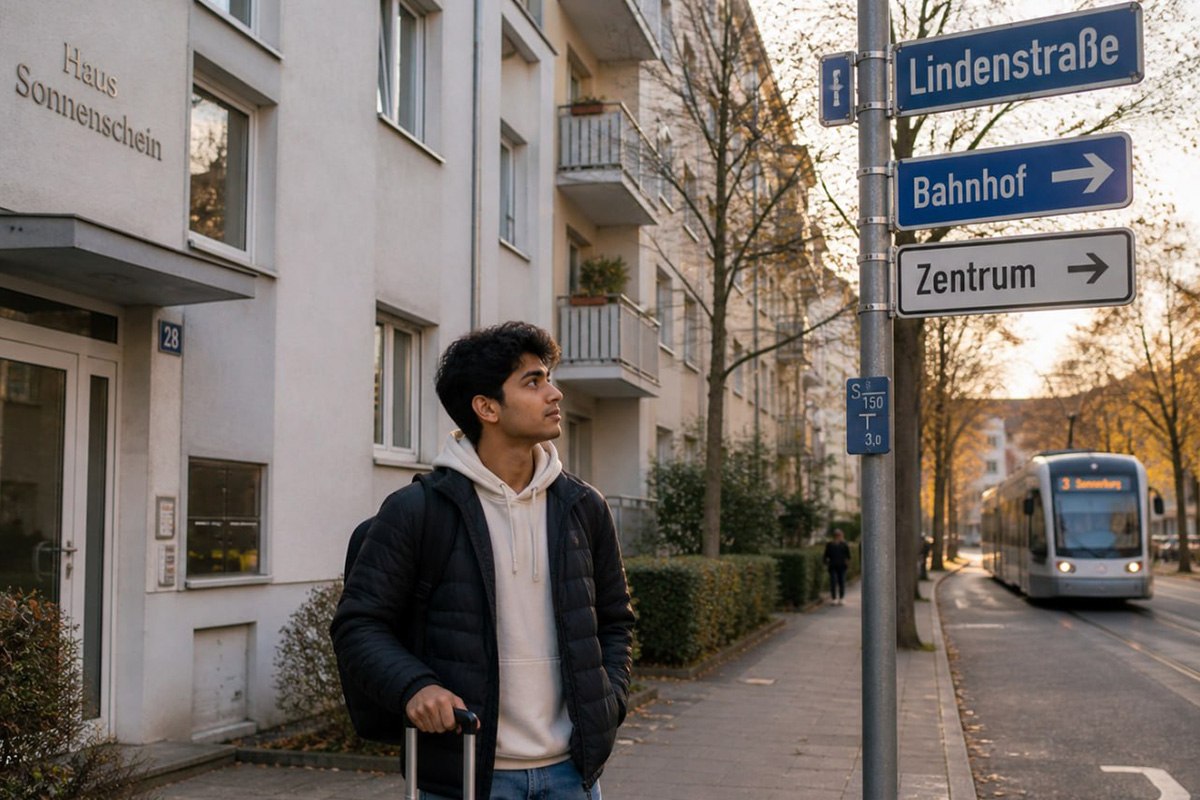
💡 In this blog: A week-by-week, honest picture of what the first month in Germany feels like for an Indian Ausbildung trainee – from the airport to the first pay slip. What surprises people, what is harder than expected, what gets easier faster than expected, and what no one tells you before you go.
Everyone talks about Germany before you go. No one really tells you what the first month feels like when you get there. The YouTube videos show you the scenery. The Instagram posts show you the food. But the actual experience of being an 18 or 20-year-old Indian student landing in a German city for the first time – alone, with a suitcase and a training contract – is something that deserves an honest telling.
This blog does that. Week by week. Based on what JSJ candidates have actually experienced in their first thirty days in Germany. The good parts and the hard parts, both.
Most JSJ candidates fly into Frankfurt, Munich, or Düsseldorf – Germany’s three main international airports. Your Destination Germany onboarding contact will have been in touch before your flight, and in most cases your employer’s Ausbildung coordinator arranges either an airport pickup or clear written instructions for how to reach your accommodation using public transport.’
The flight itself – typically 8 to 10 hours from Delhi or Mumbai – is the last moment of genuine calm for a while. Use it. Sleep if you can. The moment you land, the sensory experience of Germany begins: the airport signs in German, the cold air, the size of the terminal, the orderliness of the queues. For most Indian students, the first impression of Germany is not ‘it’s beautiful’ – it is ‘everything is very organised and very quiet.’
Your first task after landing is getting to your accommodation. If your employer has arranged a pickup, follow those instructions exactly and contact them the moment you land. If you are using public transport, your Destination Germany contact will have given you step-by-step instructions. German public transport is excellent but can be confusing if you do not know the system – S-Bahn, U-Bahn, RE, RB are all different train types. Your JSJ pre-departure briefing will have covered this. If in doubt, ask someone – Germans in stations are generally helpful to confused-looking travellers.
Your first week in Germany is not about work. It is about paperwork. This is true for every new resident in Germany, German or foreign, and it is one of the things that surprises Indian students most. The German administrative system is thorough and sequential – everything depends on doing things in the right order.
| Task | What It Is | When to Do It | Time Required |
|---|---|---|---|
| Anmeldung (address registration) | Register your address at the local Bürgeramt (citizens’ office) | Within 2 weeks of arrival – do this first | 30–90 minutes at the office + waiting time |
| Meldebescheinigung | The registration certificate you receive after Anmeldung – everything else depends on this | Same day as Anmeldung | Issued immediately |
| Steueridentifikationsnummer | Your German tax ID – sent by post after Anmeldung, takes 2–4 weeks to arrive | Register first, then wait | Arrives by post automatically |
| German bank account | Needed for your stipend to be paid – most banks require Meldebescheinigung | After Anmeldung | 1–3 days (some digital banks like N26 or DKB are faster) |
| Health insurance registration | Your employer registers you – confirm with HR on Day 1 of work | Done by employer on Day 1 | Employer handles – you just provide documents |
| SIM card / German number | German mobile number – available at any Telekom, Vodafone, or O2 shop | Day 1 or 2 | 30 minutes |
The Anmeldung is the most important first step. Without it, you cannot open a bank account, receive your tax ID, or complete most other administrative tasks. Many students underestimate how long it takes to get an appointment at the Bürgeramt in busy cities – book online the moment you arrive, or ask your employer’s HR team to help you navigate this. Destination Germany’s in-country support also assists with this process.
Most Ausbildung contracts begin one to two weeks after arrival, giving you time to complete initial admin. Your first day at your training facility is an orientation day – you are introduced to your team, shown around the facility, given your uniform, and briefed on the schedule. Your Praxisanleiter (practice educator – the person legally responsible for your on-the-job training) introduces themselves and begins explaining how your first weeks will be structured.
The most common emotional experience in the first week of work is a combination of excitement and quiet panic. The excitement comes from finally being there – this is the place you trained for, saved for, and planned for. The quiet panic comes from realising that everything is in German, and while your B2 is solid, real-life German at speed, with regional accents and professional vocabulary, is different from classroom German. This is normal. Every single JSJ candidate who has been through this reports the same thing. It gets better – faster than you expect.
In the first week of work, your primary job is to observe, ask questions, and not be afraid to say ‘Können Sie das bitte wiederholen?’ (Can you please repeat that?). German colleagues in the care sector are accustomed to working with international Azubis. Most are patient. Some will go out of their way to help you. One or two might be abrupt – that is German professional culture, not personal dislike.
Around days 14 to 21, many Indian Ausbildung trainees experience what is commonly called the emotional dip – a period where the initial excitement has faded, the novelty has worn off, and the full reality of being far from home sets in. You miss your family. You miss your food. You are tired from concentrating in German all day. You come home and do not want to talk to anyone. This is extremely common and extremely normal.
What helps most during this period, based on the consistent experience of our placed candidates: calling home regularly (video calls, not just texts), cooking a familiar Indian meal, finding one or two colleagues or other international Azubis to spend time with outside work, and reminding yourself that the discomfort is time-limited and part of a process that every person who has ever built a life somewhere new has gone through.
💬 From a JSJ candidate placed through Destination Germany, reflecting on their first month:
‘Week 3 was the lowest point. I called my mother every day. I almost thought about going home. Then I had one
good shift at work where I understood everything the senior colleague said and helped a resident by myself. That
was it – something shifted. Week 4 was completely different.’
By the end of the first month, something changes. It is hard to pinpoint exactly when – it is not a single moment but a gradual accumulation of small competences. You start understanding the morning handover without straining. You know where things are kept. You remember your colleagues’ names. You have a favourite route to work. You have figured out the supermarket layout. You have cooked dal at home twice. You have found one colleague you genuinely look forward to seeing.
Language confidence is the most visible marker of this shift. German that felt impenetrable in Week 1 starts feeling manageable in Week 4. You are not fluent by any means – that comes in Month 4 or 5 – but you are no longer panicking. You are processing. You are functioning. And you are beginning, quietly, to feel that this might actually work.
The first thirty days in Germany teach you something that no classroom in India could – that you are more capable of adaptation than you thought. You figured out the trains. You managed the admin. You survived your first German shift. You cooked in a kitchen the size of a cupboard. You called your mother at 11pm her time and told her you were okay – and meant it.
The first month is the hardest. Every month after it gets a little easier. By Month 6, most candidates cannot imagine having not made this decision. That is the arc – and it begins with thirty days that are harder and more growth-producing than anything that came before them.
Book a free demo class at our Karol Bagh centre or attend online. No commitment. No fees. Just one hour that could change your career.
Karol Bagh, New Delhi – 110008