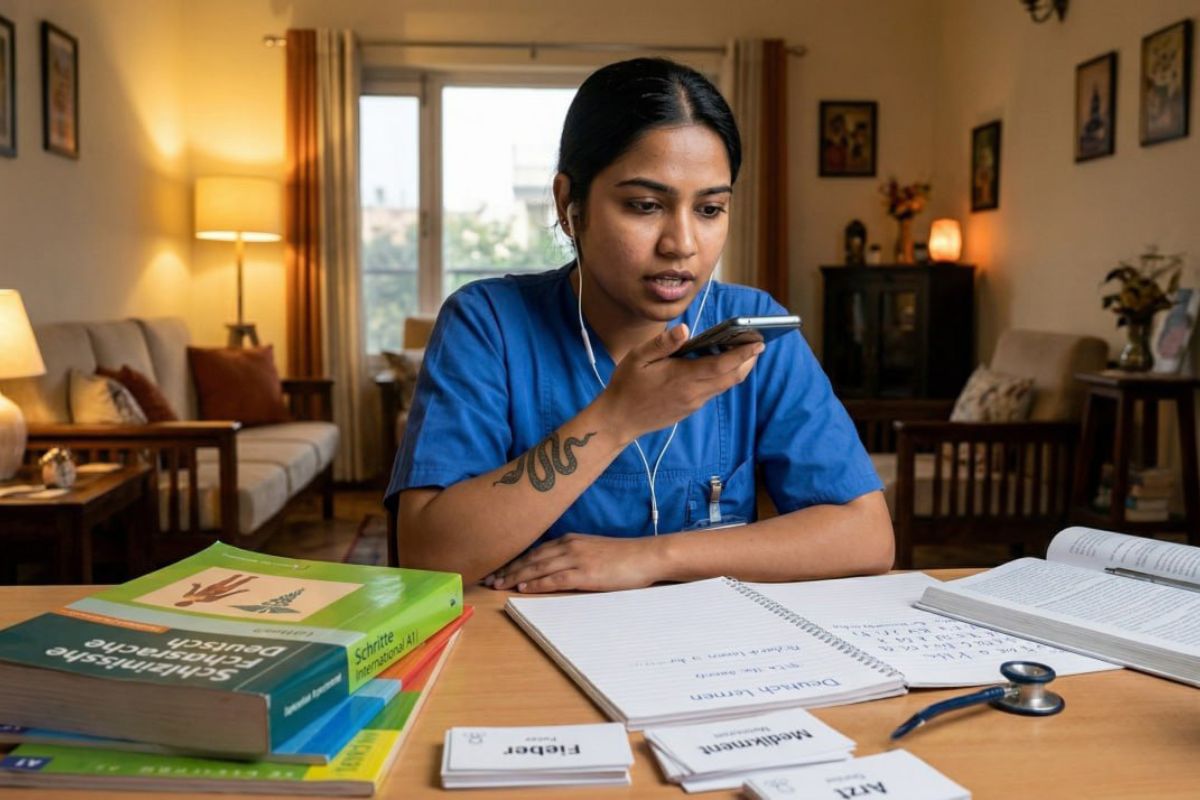
🎯 ‘I can read and write German, but I freeze when I have to speak.’ This is the
most common frustration for Indian nurses. Here are 8 proven methods to build speaking confidence – even with no
German speaker near you.
Speaking is the skill that separates confident nurses from nervous ones when they arrive in
Germany. It is also the skill Indian nurses most consistently underinvest in – because reading and writing feel
safer. The good news: you do not need a native speaker to improve dramatically.
Method 1 – Running Commentary
Every morning, describe what you are doing in German as you do it: ‘Ich stehe auf. Ich gehe ins
Bad. Ich putze die Zaehne.’ This trains your brain to think in German rather than translate. Extend this to
patient scenarios: ‘Der Patient hat Fieber. Ich messe den Blutdruck.
Method 2 – Shadowing
Listen to native German audio and repeat it simultaneously, mimicking pronunciation, rhythm,
and intonation. Deutsche Welle Learn German is free and excellent. Play one sentence, pause, repeat aloud
exactly as you heard it. 15 minutes daily.
Method 3 – German Only With Classmates
Make a rule with 2–3 classmates: during breaks, German only. Halting and full of mistakes at
first – that is the point. The nurses who progress fastest at our New Delhi centre are those who speak German
between themselves outside class hours.
Method 4 – Language Exchange Apps
Tandem and HelloTalk connect language learners worldwide. Find German speakers wanting to
practice English – 30 minutes of German for 30 minutes of English. Completely free. Many Indian nurses find
long-term language partners this way.
Method 5 – Record and Listen Back
Record a 1-minute German voice note daily – describe your day, a patient scenario, or read a
textbook paragraph aloud. Listen back. This is uncomfortable at first but it is one of the fastest ways to
identify pronunciation issues. Keep a folder – compare Week 1 to Month 6.
Method 6 – German TV With German Subtitles
Watching German TV with German subtitles trains ears and eyes simultaneously. Recommended: Easy
German (YouTube, free – natural spoken German), Deutsche Welle Nachrichten (news in simple German), Nicos Weg
(learner-focused German drama, free, A2–B1 level).
Method 7 – Patient Scenario Practice Out Loud
- Admitting a patient: ‘Guten Tag, ich bin Ihre Pflegekraft heute. Wie heissen Sie?’
- Asking about pain: ‘Haben Sie Schmerzen? Auf einer Skala von 1 bis 10?’
- Explaining a procedure: ‘Ich moechte jetzt Ihren Blutdruck messen.’
- Shift handover: ‘Der Patient in Zimmer 3 hatte heute Morgen Fieber…’
Practice these out loud until they feel natural. Then with a classmate.
Method 8 – Set Your Phone to German
Change your phone language to German. You interact with your phone more than any other device
and already know every menu. Your brain absorbs vocabulary and sentence patterns passively all day. Slightly
disorienting for the first week – then completely natural.
The Most Important Reminder
German healthcare professionals work with international colleagues every day. They need clear
communication, appropriate vocabulary, and the confidence to speak – not a perfect accent. All three come from
daily practice. Nurses who arrive in Germany and adapt fastest are almost always those who spoke the most during
training – mistakes included.
📞 Free Consultation – Call / WhatsApp: / +91
96259 66817 Email: support@jetsetjobs.in
Website: Jet
Set
Jobs.in 583+ nurses have started their journey with Jet Set Jobs. Free B2 training. Zero recruitment
fees.