🛡️ Licensed by Ministry of External Affairs · RA:
B-3413/DEL/COM/1000+/5/11419/2026
📞 +91 96259 66817
📍 15, 2nd Floor, South Patel Nagar, Delhi-110008
 JET SET JOBS
Settle Abroad with Jet Set Jobs
JET SET JOBS
Settle Abroad with Jet Set Jobs
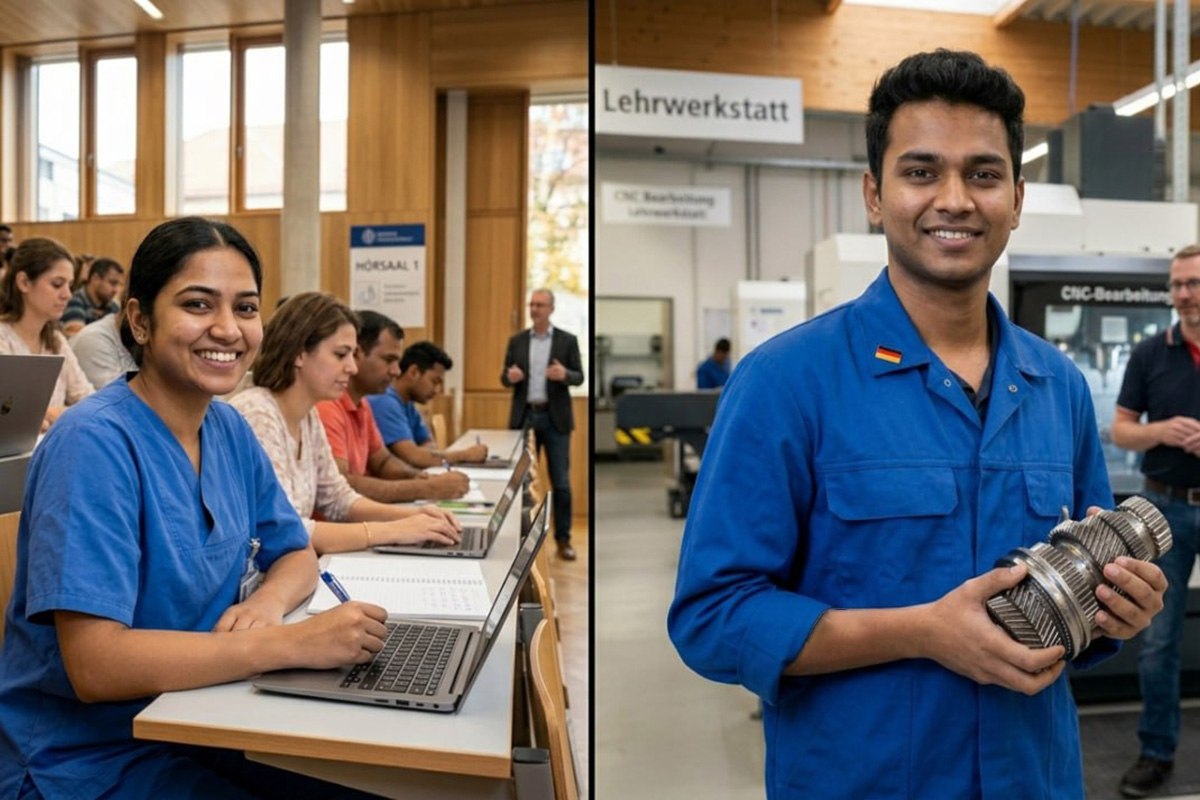
This blog compares Ausbildung and university study in Germany side by side – costs, income, visa type, PR timeline, and which path makes more sense depending on your situation.
Germany has long been a destination for Indian university students, particularly those pursuing engineering, management, or computer science at master’s level. But in 2026 and 2027, a different conversation is growing – is Ausbildung actually a better option than university for many Indians? The honest answer, based on real numbers and real outcomes, is: for a large number of people, yes.
This is not a criticism of university education. A postgraduate degree from a German university is genuinely valuable. But it comes with assumptions that do not hold for every Indian family – assumptions about tuition money, about the ability to work enough part-time hours to cover costs, and about what happens if you cannot find a job in your specialisation after graduation. Ausbildung changes those assumptions entirely.
| Factor | Ausbildung | University (Germany) |
|---|---|---|
| Minimum qualification | 12th pass (any stream) | Bachelor’s degree (for Master’s) |
| Age range | Ideally 18–25 years | Any adult age |
| Tuition fees | Zero – employer pays you | €0 at public universities (but living costs) |
| Monthly income during study | €900–€1,300/month stipend | Part-time work only – max €600–€900/month typical |
| Duration | 2–3.5 years | 1.5–2 years (Master’s) or 3–4 years (Bachelor’s) |
| Visa type | Vocational Training Visa §16a | Student Visa §16b |
| Language requirement at start | B2 minimum (A1 to start JSJ programme) | B2/C1 for German-medium; IELTS for English-medium |
| Qualification received | German federal vocational certificate (IHK/HWK) | Bachelor’s or Master’s degree |
| PR eligibility | After Ausbildung + 2 years work | After degree + 2–5 years skilled work typically |
| Employer commitment | Employer signed before you arrive | No employer guarantee after graduation |
| Job placement rate | 90%+ hired by training employer | Varies – no guarantee |
The most striking difference between the two paths is financial. A university student in Germany earns nothing during their studies unless they work part-time, which is capped and limited by visa conditions. In contrast, an Ausbildung trainee earns a full stipend from their employer from day one – typically between €900 and €1,300 per month depending on the sector and year of training. Over three years, that translates to roughly €32,000 to €46,000 in total stipend income. That is not pocket money. For many Indian families, this is the factor that tips the decision.
Many Indians assume that a university degree is inherently superior to a vocational qualification. In Germany, this assumption does not hold in the same way it might in India. German society treats Ausbildung qualifications with genuine respect. A qualified mechatronics technician or healthcare professional from an Ausbildung programme is not looked down upon – they are in high demand. Skilled trades and vocational roles in Germany are well-compensated, socially respected, and critically understaffed. The same cannot always be said of generic bachelor’s degree holders in oversupplied fields.
For Indians whose long-term goal is to settle in Germany or Europe, the Ausbildung pathway is actually faster and more predictable. University graduates typically need to find a skilled job after graduation, then accumulate enough years of employment to become eligible for permanent residency. This process can take anywhere from four to seven years after arrival, with no guarantee of employment. With Ausbildung, your employer is confirmed before you leave India. Your training counts as employment. After completing your training and working for two more years, you become eligible for PR – making the total timeline roughly five years from arrival, with a far more predictable trajectory.
University in Germany makes strong sense for an Indian who has already completed a relevant bachelor’s degree, has a specific research or technical field they want to pursue at postgraduate level, is comfortable with the financial uncertainty of student life, and has strong German or English language skills already in place. Ausbildung makes strong sense for an Indian who is 18 to 25 years old and has Class 12 as their highest qualification, wants financial independence from the moment they arrive in Germany, has a practical career orientation rather than an academic one, wants the security of an employer commitment before they travel, and is willing to invest 3 years for a qualification, income, and a clear PR pathway.
Neither path is wrong. But for Indians in their early twenties who are not yet graduates and want financial certainty in Germany, Ausbildung is the more realistic and more immediately rewarding option.
Through our joint Ausbildung programme with Destination Germany, we place Indian candidates in verified German employer positions across healthcare, engineering, logistics, IT, and hospitality. The programme is designed for candidates who have Class 12 as their minimum qualification. You do not need prior German knowledge – our 8 certified trainers take you from A1 through to the level needed for your Ausbildung placement. The total programme fee is ₹2,50,000 + GST, paid across three confirmed milestones. You pay ₹10,000 to register. Everything else follows real outcomes – an employer offer letter, then language clearance. You are never paying into uncertainty.
Book a free demo class at our Karol Bagh centre or attend online. No commitment. No fees. Just one hour that could change your career.
Karol Bagh, New Delhi – 110008