🛡️ Licensed by Ministry of External Affairs · RA:
B-3413/DEL/COM/1000+/5/11419/2026
📞 +91 96259 66817
📍 15, 2nd Floor, South Patel Nagar, Delhi-110008
 JET SET JOBS
Settle Abroad with Jet Set Jobs
JET SET JOBS
Settle Abroad with Jet Set Jobs
💡 In this blog: A plain-language breakdown of the German language levels you will hear about in every Ausbildung programme – what A1, A2, B1 and B2 mean in real terms, which level you need for Ausbildung, and how JSJ takes you from zero to B1 in five months.
When people start researching Ausbildung in Germany, one of the first things they encounter is a series of letters and numbers: A1, A2, B1, B2. These come up in every eligibility requirement, every visa application guide, and every Ausbildung job posting. But what do they actually mean? And which one do you need?
This blog answers both questions completely – and explains exactly how the JSJ language training programme works, so you know what to expect from the moment you enrol.
A1, A2, B1, B2, C1, and C2 are levels defined by the Common European Framework of Reference for Languages – known as the CEFR. It is an international standard created by the Council of Europe to describe language ability across six levels, from complete beginner (A1) to near-native mastery (C2). Every major European language – including German – uses this framework, and every official German language examination (TELC, Goethe-Institut, ÖSD) is aligned to it.
When a German employer says they want a B2-level candidate, they mean a candidate who has reached the B2 level on this scale. When a German Embassy asks for a B2 certificate, they want an officially issued exam result from an authorised centre confirming that level. Understanding the framework is the first step to understanding what is being asked of you
| Level | What You Can Do | How Long to Reach From Zero (Full-Time Study) |
|---|---|---|
| A1 – Beginner | Introduce yourself, ask simple questions, understand very slow speech, read basic signs | 2–3 months |
| A2 – Elementary | Handle simple transactions, discuss daily routine, understand short texts, basic conversation | 2–3 months from A1 |
| B1 – Intermediate | Hold conversations about familiar topics, understand clear speech in most situations, write simple letters and messages | 2–3 months from A2 |
| B2 – Upper Intermediate | Discuss complex topics, understand most native speech, write detailed texts, interact confidently in a professional setting | 3–4 months from B1 |
| C1 – Advanced | Express ideas fluently with little effort, understand demanding texts, negotiate and explain with precision | 4–6 months from B2 |
The minimum German language level required to begin Ausbildung in Germany is B2. This is the level at which you can hold real conversations, understand instructions at work, and manage daily life independently. Some German employers will interview candidates at B1 if they are confident the candidate will reach B2 before their Ausbildung start date – but B2 is the standard entry point and the level required for the §16d Recognition Visa application.
JSJ strongly recommends reaching B2 before you begin working in Germany – not as a visa requirement, but as a practical one. Your Berufsschule classes are in German. Your work discussions are in German. Your supervisor’s instructions are in German. The higher your language level when you arrive, the faster you settle in, the better your performance reviews, and the more confident you feel in those critical first months.
📋 Language level summary for Ausbildung candidates:
B2 = Minimum for §16d visa application and to begin Ausbildung.
B2 = Required. JSJ trains you to B2 as the programme standard.
JSJ trains you from A1 (zero) to B2 as part of the programme fee.
B2 training is available as an extension – discuss with your counsellor.
The official B2 examination for German is offered by two main bodies in India: TELC (The European Language Certificates) and the Goethe-Institut. Both are fully recognised by German embassies and employers. The TELC B2 exam tests four skills – reading (Lesen), listening (Hören), writing (Schreiben), and speaking (Sprechen). You must pass all four components to receive the certificate.
The exam is not easy – but it is also not unreachable for a student who has trained consistently over four to five months. The content is practical, not academic: understanding announcements, filling in forms, writing short messages, describing situations, and having structured conversations. These are exactly the skills JSJ’s training programme builds.
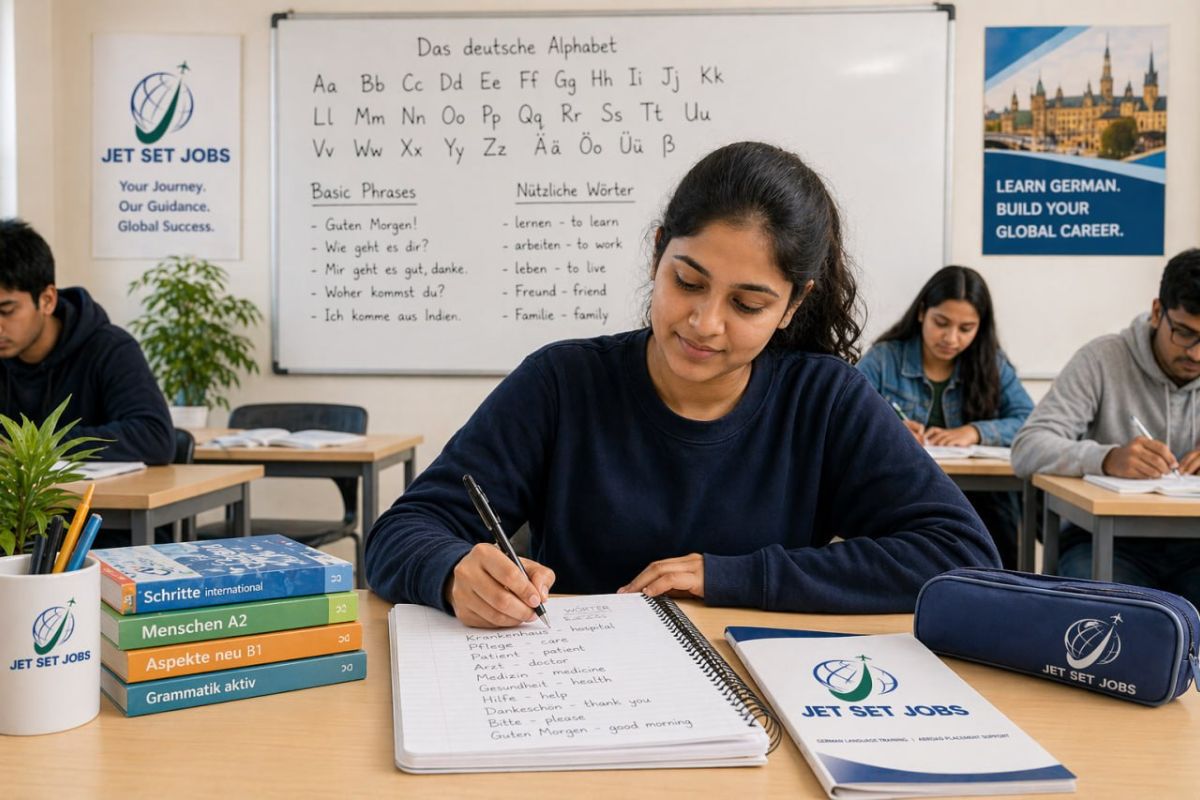
When you enrol in the JSJ Ausbildung programme, you begin German language training from whatever level you are at – even if that is zero. Our certified teach from the South Patel Nagar campus and online via the LMS.
The A1 phase (months one and two) covers the German alphabet, pronunciation, basic sentence structure, numbers, days, months, colours, greetings, and simple present tense. Most students find A1 more manageable than they expected – German grammar is logical, and the structure is consistent once you understand the rules.
The A2 phase (months two and three) introduces past tense, modal verbs, prepositions, and expands vocabulary to cover home, daily routine, shopping, travel, and describing people. This is where many students hit their first real challenge – German grammar has three genders (der, die, das) and case changes that take time to internalise. Consistency in practice is what gets you through it.
The B2 phase (months five and six) focuses on advanced conversations, understanding longer listening texts, writing structured messages and short essays, and building the advanced vocabulary and grammar precision needed for professional use – complex sentences, formal writing, and nuanced listening comprehension. Your Berufsschule vocabulary, care terminology, and formal workplace German are deepened at this stage.
Classes run five days a week – a mix of classroom sessions in South Patel Nagar and online sessions on LMS for revision and practice. Mock B2 tests are conducted monthly, and your progress is tracked by your dedicated trainer. JSJ will not submit your visa application until you have genuinely cleared B2.
No. You can apply to JSJ at zero German – and most of our Ausbildung candidates do exactly that. The language training is the first thing that happens after enrolment. What you need is not existing German knowledge – it is the motivation to learn it, the discipline to attend classes six days a week, and the understanding that your language level in Germany is directly linked to your success there.
Students who treat the language training seriously and consistently – who do the homework, attend the mock tests, and practise beyond class hours – reach B2 within the five to six month window. Students who attend irregularly or do not practise independently take longer and sometimes need to extend their training period before the visa application stage.
German is learnable. Hundreds of Indian students have done it through the JSJ programme. The question is not whether you can learn it – it is whether you are prepared to put in the consistent effort required.
📞 Book Your Free Consultation – Jet Set Jobs × Destination Germany
Call /
WhatsApp: +91
96259 66817
support@jetsetjobs.in | www.jetsetjobs.in
Ausbildung Programme Germany 2027
Eligibility: Age 18–25 | Class 12 pass | Science background preferred
Programme fee: ₹2,50,000 + GST in 3 instalments
Free German A1–B2 training included | Stipend: €1,000–€1,300/month in Germany
Book a free demo class at our Karol Bagh centre or attend online. No commitment. No fees. Just one hour that could change your career.
Karol Bagh, New Delhi – 110008