🛡️ Licensed by Ministry of External Affairs · RA:
B-3413/DEL/COM/1000+/5/11419/2026
📞 +91 96259 66817
📍 15, 2nd Floor, South Patel Nagar, Delhi-110008
 JET SET JOBS
Settle Abroad with Jet Set Jobs
JET SET JOBS
Settle Abroad with Jet Set Jobs
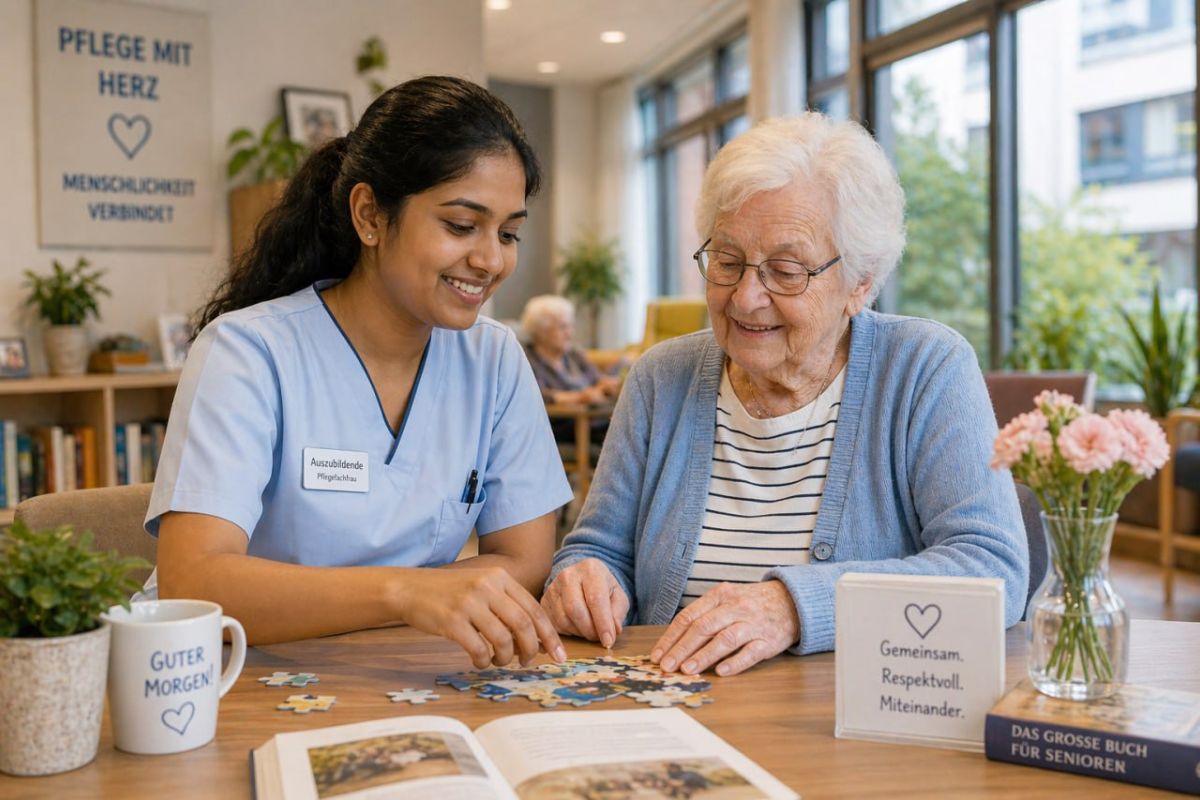
💡 In this blog: A clear, honest explanation of what Germany’s care sector is, what Ausbildung trainees in this field actually do at work every day, why it is well-suited to Class 12 science students, and why it is one of the most in-demand Ausbildung tracks in Germany.
When Indian students hear ‘care sector Ausbildung in Germany,’ one of the most common reactions is: ‘What does that actually mean? What will I be doing every day?’ It is a fair question. The care sector in Germany is large, varied, and professional in ways that are not always well understood from India.
This blog gives you a clear, practical picture of what Germany’s care sector looks like, what Ausbildung trainees in this field do on a typical day, and why a Class 12 background with a science focus is genuinely useful for this kind of work.
65 or older – and that number is growing every year. Caring for this population is one of the country’s most critical economic and social priorities. The care sector in Germany (Pflegebranche or Sozialbranche) encompasses a wide range of services and settings: elder care facilities (Pflegeheime), community care services (ambulante Pflegedienste), day care centres (Tagespflegeeinrichtungen), supported living facilities, and social work organisations.
The professionals who work in this sector range from care assistants to qualified care professionals, social workers, and specialists. Ausbildung is the primary pathway into this sector – the government-certified three-year training that prepares you to work independently as a qualified care professional.
| Track | German Name | Setting | Duration | What You Do |
|---|---|---|---|---|
| Qualified Care Professional | Pflegefachmann / Pflegefachfrau | Hospitals, elder care homes, community care | 3 years | Comprehensive practical care across multiple settings and age groups |
| Geriatric Care Specialist | Altenpfleger / Altenpflegerin | Elder care homes, day centres, home visits | 3 years | Specialised care for elderly residents – daily support, activities, documentation |
| Care Assistant Foundation | Pflegehilfskraft | Elder care, community settings | 1 year (foundation) | Foundational care support under supervision – pathway to full qualification |
The JSJ programme focuses primarily on the Pflegefachmann / Pflegefachfrau (Qualified Care Professional) track – the most comprehensive and most versatile qualification in the sector, valid across hospitals, elder care, and community settings throughout Germany and the EU.
Here is an honest picture of what a day as an Ausbildung trainee in a German care facility looks like in Year 1:
By Year 2, you have more independence and more complex responsibilities. By Year 3, you are functioning close to a qualified professional – the final year is largely about consolidating and demonstrating that you can work autonomously within the care team.
The care sector in Germany is far more scientific and systematic than many people expect. Anatomy, physiology, pharmacology, infection control, nutrition science, and psychological understanding of ageing are all integral parts of the Berufsschule curriculum and the practical day-to-day work. A student who has studied Biology and Chemistry at Class 12 level has already built a conceptual foundation for these areas.
You will not be doing chemistry experiments at work. But you will be understanding why a resident’s medication affects their appetite, or why a particular hygiene protocol exists, or how to read a clinical assessment form. A science background means these concepts land faster and stick more easily – which is why JSJ specifies it as a preferred criterion.
| Year | Key Skills Developed |
|---|---|
| Year 1 | Basic care techniques, documentation in German, professional communication, understanding care regulations, working within a team |
| Year 2 | Specialist care procedures, independent case management (with supervision), professional report writing, handling complex situations with empathy |
| Year 3 | Near-autonomous professional practice, advanced documentation, preparing and presenting case assessments, preparing for state examination |
It is honest to acknowledge this. Working in the care sector means being present with people who are vulnerable, sometimes confused, sometimes in pain. There are days that are harder than others. Residents pass away, and you will be part of a team that responds to that with professionalism and humanity. This is not a job you can do on autopilot – it requires genuine presence.
At the same time, most Ausbildung trainees in this sector describe it as deeply rewarding in a way that desk jobs rarely are. You finish a shift knowing that you made a tangible difference to someone’s day. The relationships you build with residents – who recognise you, light up when you come in, tell you stories, and appreciate your presence – are unlike any other professional relationship. Many of our placed candidates describe this as the aspect of their work they least expected to value, and the one they talk about most.
📞 Book Your Free Consultation – Jet Set Jobs × Destination Germany
Call /
WhatsApp: +91
96259 66817
support@jetsetjobs.in | www.jetsetjobs.in
Ausbildung Programme Germany 2027
Eligibility: Age 18–25 | Class 12 pass | Science background preferred
Programme fee: ₹2,50,000 + GST in 3 instalments
Free German A1–B2 training included | Stipend: €1,000–€1,300/month in Germany
Book a free demo class at our Karol Bagh centre or attend online. No commitment. No fees. Just one hour that could change your career.
Karol Bagh, New Delhi – 110008