🛡️ Licensed by Ministry of External Affairs · RA:
B-3413/DEL/COM/1000+/5/11419/2026
📞 +91 96259 66817
📍 15, 2nd Floor, South Patel Nagar, Delhi-110008
 JET SET JOBS
Settle Abroad with Jet Set Jobs
JET SET JOBS
Settle Abroad with Jet Set Jobs
🎯 Before you move to Germany, you need to know what life actually costs – not optimistic estimates, but real numbers. This blog breaks down every major expense category city by city, so you can plan your budget accurately before you arrive.
Understanding the cost of living in Germany is essential before making the move – because your savings potential depends not just on what you earn, but on what you spend. The good news is that Germany, despite being a high-income country, is significantly more affordable than many Indian nurses expect – particularly outside the major cities.
This blog gives you accurate, current figures for every major expense category, so you can build a realistic monthly budget and understand exactly what your financial life in Germany will look like.
Rent is your largest monthly cost in Germany, and it varies enormously by city. Most newly arrived nurses live in a Wohngemeinschaft (WG) – a shared flat where you rent a furnished room and share the kitchen and bathroom with flatmates. This is the most affordable and most common option for international nurses in their first year
| City / Region | Monthly Rent (1 room, WG) | Germany’s most expensive city – beautiful but costly |
|---|---|---|
| Munich (München) | €800–€1,200 | Germany’s most expensive city – beautiful but costly |
| Frankfurt | €700–€1,000 | Major financial centre – high rents |
| Hamburg | €650–€950 | Large port city – moderate to high |
| Berlin | €600–€900 | Large city but relatively affordable for its size |
| Cologne (Köln) | €550–€800 | Western Germany – good balance |
| Stuttgart | €600–€850 | Strong industrial city – moderate |
| Düsseldorf | €550–€800 | NRW – very manageable |
| Leipzig / Dresden | €350–€550 | Eastern Germany – very affordable |
| Smaller towns / rural areas | €300–€500 | Most affordable – common for care home placements |
💡 Most care homes (Pflegeheime) are located in smaller towns and rural areas – where rent is lowest. This is actually an advantage for nurses placed in care homes: lower rent + good salary = higher savings than nurses in major cities.
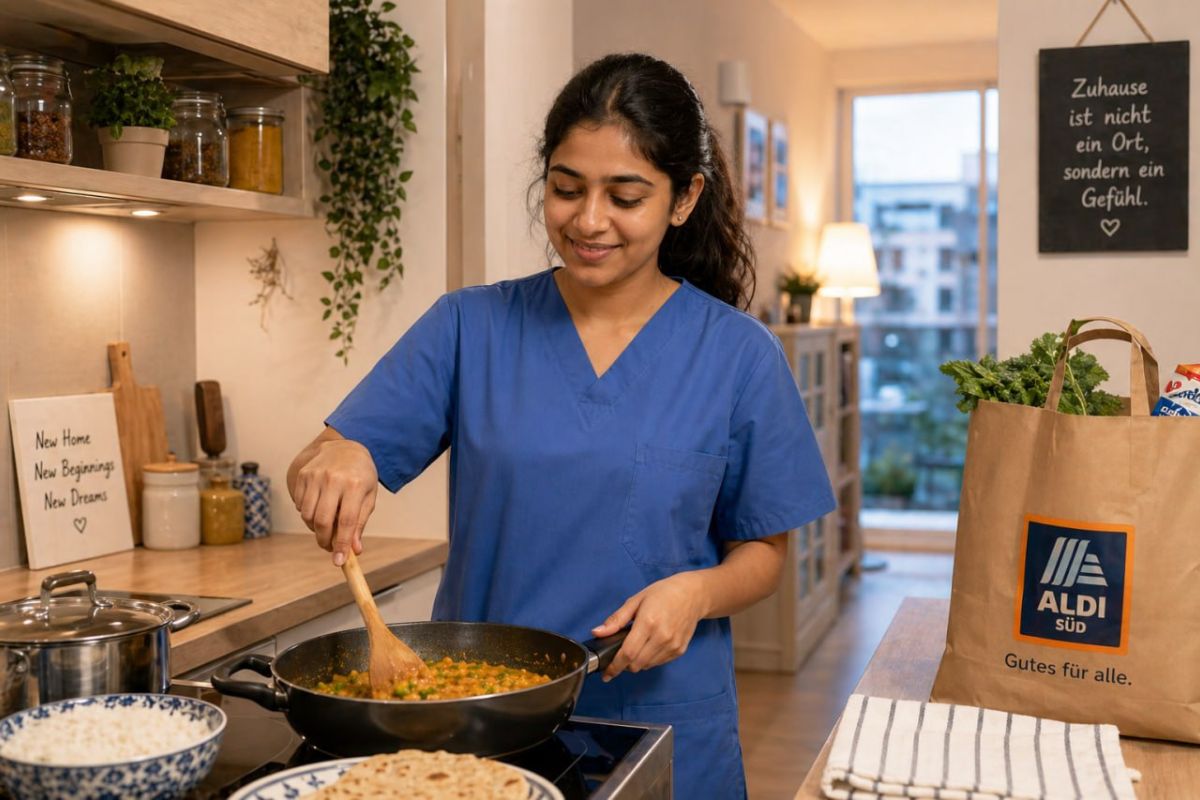
Germany has excellent, affordable supermarkets. The main chains are ALDI, LIDL, REWE, EDEKA, and Penny – all significantly cheaper than equivalent shopping in Indian metros for comparable quality. Indian nurses consistently report that grocery bills are lower than expected.
| Item | Cost | Notes |
|---|---|---|
| Monthly groceries (cooking at home) | €150–€250/month | Indian spices available in Asian shops in most cities |
| Eating out (casual restaurant) | €8–€15 per meal | German fast food, kebab shops, Asian restaurants |
| Coffee / tea at a café | €2.50–€4.50 | |
| Lunch at hospital canteen | €4–€7 | Most hospital canteens are subsidised |
| Monthly food budget (realistic) | €200–€350/month | If cooking at home most days |
Indian groceries – rice, dal, spices, atta – are available in every German city at Indian or Asian grocery stores. Larger cities like Frankfurt, Stuttgart, Berlin, and Cologne have well-stocked Indian supermarkets. Prices are higher than India but completely manageable on a German nurse’s salary.
Germany has excellent public transport – U-Bahn (metro), S-Bahn (suburban rail), trams, and buses cover most cities comprehensively. Most nurses do not need a car in their first year, particularly if their hospital or care home is in a connected area.
| Transport Option | Cost | Notes |
|---|---|---|
| Monthly public transport pass (Monatskarte) | €50–€100/month | Many hospitals subsidise or provide this free |
| Deutschlandticket (national travel pass) | €29–€49/month | Valid on all local/regional public transport across Germany – excellent value |
| Bicycle (one-time purchase, second-hand) | €80–€200 one-time | Most popular daily transport for nurses – free ongoing |
| Car (if needed) | €300–€600/month total | Insurance + fuel + maintenance – only needed in rural areas without transport |
| Item | Cost | Notes |
|---|---|---|
| German SIM card (prepaid or contract) | €15–€30/month | Aldi Talk, Lidl Connect, O2, Telekom – all good options |
| Home internet (if sharing with flatmates) | €10–€20/month (your share) | Split between flatmates – usually included in WG rent |
| International calls to India | Free via WhatsApp/FaceTime | WiFi calling – no extra cost |
| Item | Cost | Notes |
|---|---|---|
| Health insurance | Deducted from salary automatically – employer + employee split | No separate payment needed for GKV |
| Household items (first setup) | €200–€500 one-time | IKEA, second-hand shops (Secondhand, eBay Kleinanzeigen) – affordable |
| Clothing | €50–€150/month | Optional – German retail is well-priced; many nurses shop sales |
| GEZ (public broadcasting fee) | €18.36/month per household | Mandatory contribution to German public broadcasting – split with flatmates |
| Leisure / entertainment | €50–€100/month | Museums, parks, local events – many free or very affordable |
| Remittance to India | As per preference | Most nurses send ₹30,000–₹80,000 home per month |
| Location | Monthly Expenses (Approximate) | Savings from Recognition Phase Net |
|---|---|---|
| Small town / care home placement | €350 rent + €200 food + €30 transport + €25 phone + €100 other = €705/month | Highest savings potential – net salary of ~€1,950 leaves ~€1,245 savings |
| Medium city (Cologne, Düsseldorf) | €650 rent + €270 food + €60 transport + €25 phone + €150 other = €1,155/month | Net salary ~€1,950 leaves ~€795 savings |
| Major city (Berlin, Hamburg) | €800 rent + €300 food + €80 transport + €30 phone + €150 other = €1,360/month | Net salary ~€1,950 leaves ~€590 savings |
Post-recognition, with a net salary of approximately €2,250 per month, savings increase by approximately €300 across all scenarios – bringing small town nurses to €1,500+ in monthly savings.
Book a free demo class at our Karol Bagh centre or attend online. No commitment. No fees. Just one hour that could change your career.
Karol Bagh, New Delhi – 110008