
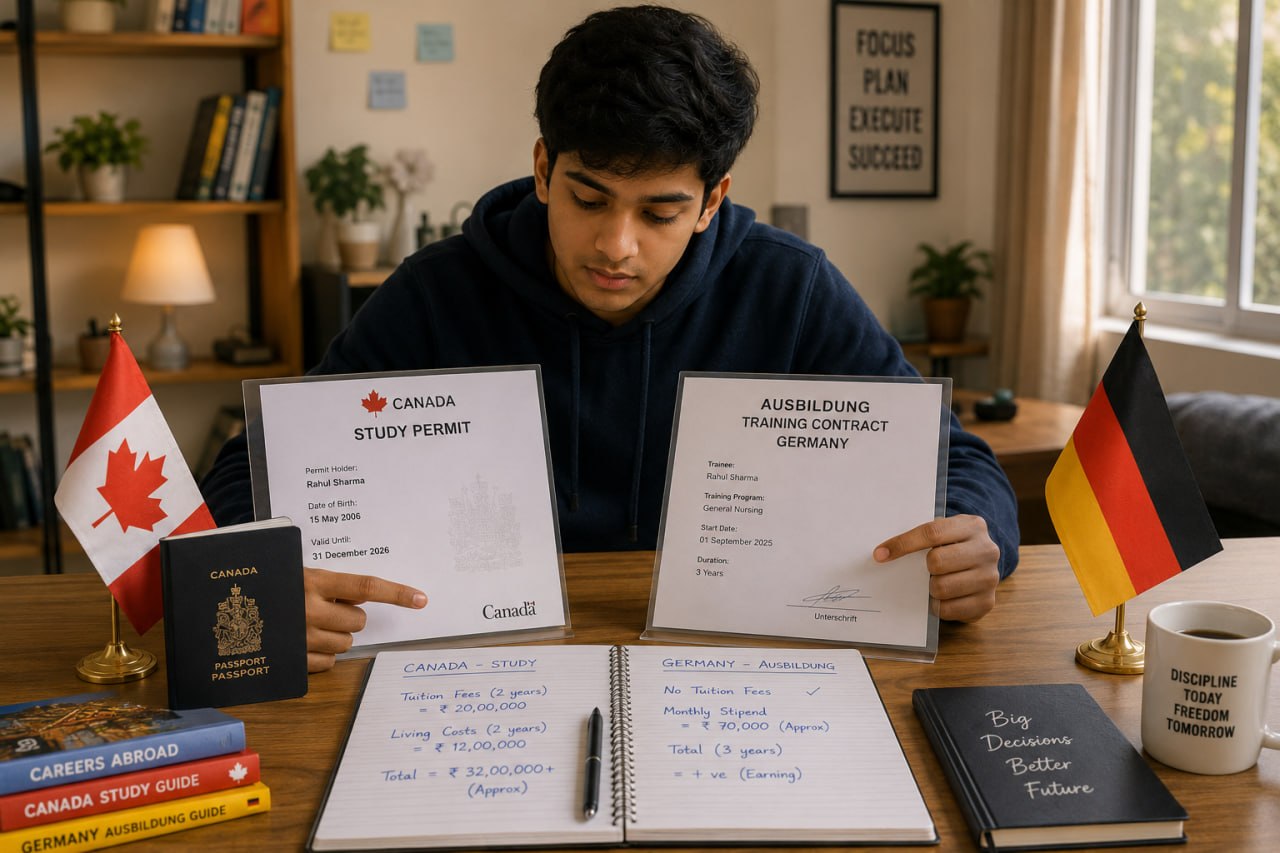
Canada has become one of the most popular study-abroad destinations for Indian families in the past decade. The reasons are understandable: English instruction, a multicultural society, a reputation for safety, and — critically — a pathway to permanent residency that many families believe is straightforward. Hundreds of thousands of Indian students apply for Canadian study permits every year.
The reality of that pathway, however, is significantly more complicated than the immigration consultants who earn commissions from Canadian college enrolments typically explain. And when it is compared honestly to Germany's Ausbildung — cost for cost, outcome for outcome — the contrast is stark.
This blog makes that comparison completely, for an Indian family with a Class 12 student aged 18–25 who is weighing both options.
The Canada Study Route — What It Actually Looks Like
The most common Canada route for Indian students after Class 12 is a one-year college diploma or two-year college programme at a Canadian Designated Learning Institution (DLI), followed by a Post-Graduation Work Permit (PGWP), followed by an attempt to qualify for Permanent Residency through Express Entry or a Provincial Nominee Programme (PNP). In theory, this produces a PR within three to five years of arriving in Canada. In practice, the route has become significantly more congested, expensive, and uncertain than it was five years ago.
The Cost Comparison — Canada vs Germany Ausbildung
| Cost Factor | 🇨🇦 Canada (2-year college diploma) | 🇩🇪 Germany Ausbildung via JSJ (3 years) |
|---|---|---|
| Tuition fees | CAD $15,000–$25,000/year (international rate) — ₹9–15L/year | Zero — employer pays for vocational school |
| Accommodation | CAD $8,000–$15,000/year — ₹5–9L/year | €500–€700/month — covered by stipend |
| Food and daily expenses | CAD $5,000–$8,000/year — ₹3–5L/year | €200–€300/month — covered by stipend |
| Health insurance | CAD $600–$2,000/year (province-dependent) | Zero — employer contributes from Day 1 |
| Travel (India–Canada) | CAD $1,500–$2,500/year | €600–€900/year |
| IELTS / language tests | ₹15,000–₹20,000 (mandatory for admission) | B2 German training included in JSJ fee |
| Visa / study permit fees | CAD $150 study permit + biometrics + embassy fees | ₹25,000–₹40,000 (§16d visa, one-time) |
| Total 2-year cost | CAD $60,000–$100,000 (₹36–60 lakhs) | ₹2,50,000 programme fee + stipend covers all living costs |
| Income during programme | CAD $14/hr max 24 hrs/week off-campus — limited | €1,000–€1,300/month — full paid employment from Day 1 |
The two-year Canadian diploma costs an Indian family ₹36 to ₹60 lakhs, depending on the province and institution. The Germany Ausbildung costs ₹2,50,000 in programme fees — and your child earns approximately ₹33–37 lakhs in stipend over three years. The net financial gap is enormous. And that is before you look at what the two paths produce at the end.
The Canada PR Route — What Has Changed and What Families Are Not Being Told
The Canada permanent residency pathway through study has become significantly harder in the past two to three years. Here is the honest picture:
- PGWP: After completing a two-year programme, Indian students receive a two-year PGWP allowing work in Canada. This is the starting point — not the destination.
- Express Entry: Canada's main skilled worker PR system. Indian applicants frequently need CRS scores of 480–520+ to receive an Invitation to Apply (ITA). Many candidates wait for years without receiving an ITA.
- Provincial Nominee Programmes (PNPs): Each province has its own immigration streams. These have become increasingly competitive and are subject to annual quota changes and policy reversals.
- Processing times: Canadian PR processing times have increased significantly — from 6 months to 12–24 months in many categories.
- Recent policy tightening: In 2024, Canada announced significant reductions in international student admissions, capped study permit approvals, and signalled intent to reduce immigration intake.
📊 The Canada PR reality for Indian students after Class 12 (2025 onwards):
Study permit approval: Now capped — not all applications approved
Express Entry CRS score needed: 480–520+ for most draws
PR timeline from arrival: 3–6 years if CRS score is competitive; longer if not
Cost to family: ₹36–60 lakhs for 2-year diploma + living + PR process fees
Germany Ausbildung via JSJ:
No cap on §16d visa approvals for qualified candidates with employer offer
Permanent residency: Legally guaranteed after 2 years post-qualification
Cost to family: ₹2,50,000 programme fee — student earns ₹33–37L in stipend
PR timeline from arrival: 5 years total (3 Ausbildung + 2 post-qualification)
The Work Rights Comparison — During Study
Canada changed its international student work rules in 2023, allowing off-campus work up to 24 hours per week. At Canadian minimum wage of approximately CAD $14–17/hour, maximum weekly earnings are CAD $350–400 gross — roughly ₹66,000–₹78,000/month net after tax.
In Germany, your Ausbildung child is on the payroll of a German employer from their first month. Year 1 net take-home: approximately €800–€870/month — roughly ₹70,000–₹76,000/month. The income is comparable. But in Canada, your child is also paying ₹36–60 lakhs in tuition. In Germany, there is no tuition. The difference is structural.
The Language Question — Is English Worth ₹35 Lakhs Extra?
The primary advantage Canada has over Germany is language. Canada operates in English, which Indian students are already comfortable with. Germany requires learning German to B2. That is a real advantage for Canada — and it is worth being honest about it.
But the question is not whether English is more comfortable than German. The question is whether that comfort advantage is worth an additional ₹35–55 lakhs in family expenditure, a PR process that is increasingly competitive and uncertain, and a destination that has been actively reducing its international student intake. German is learnable. JSJ trains every Ausbildung candidate from A1 to B2 as part of the programme fee. The language barrier is a temporary challenge. The financial and immigration certainty of Germany's Ausbildung pathway is a permanent advantage.
Who Should Still Choose Canada?
Canada remains a legitimate pathway for some Indian students — particularly those who already hold strong English academic qualifications, have IELTS scores above 7.0, have family connections already in Canada who can provide housing support, and are targeting specific provinces with active PNP streams for their profession.
But for the average Class 12 science student aged 18–19 who does not have Canadian family connections, whose family is paying for tuition out of savings, and who is looking at the Canada route based on an immigration consultant's optimistic projections — the comparison with Germany Ausbildung should be made before any money is committed.
📞 Book Your Free Consultation
Jet Set Jobs × Destination Germany
Eligibility: Age 18–25 | Class 12 pass | Science background preferred
Programme fee: ₹2,50,000 + GST in 3 instalments
Free German A1–B2 training included | Stipend: €1,000–€1,300/month in Germany